Benchmarks¶
Head-to-head matrix sweep of decimal-scaled against the wider Rust
numeric ecosystem (bnum, ruint, rust_decimal, fixed), plus
the crate's own fast / strict transcendental variants. Every
decimal width is exercised at three scales (smallest / midpoint /
largest) so the reader can see how cost scales with both storage
width and SCALE.
The benches live in benches/ and run under
criterion. The baseline crates
(bnum, ruint, rust_decimal, fixed, i256) are
dev-dependencies only - they are never compiled into a normal
build.
cargo bench --features "wide x-wide" --bench full_matrix
cargo bench --features wide --bench wide_int_backends
cargo bench --features wide --bench d_w128_mul_div_paths
Absolute timings are machine-dependent. The ratios between implementations on the same machine, in the same run, are what matters. Operands are
black_box-ed to defeat constant folding; outputs are returned from the closure so the optimiser cannot drop the call. Every row uses one unit - the median natural unit across that row's cells - so values compare directly. Cells whose natural unit is smaller than the row's chosen one are rendered as plain decimals (e.g.0.00146 µsfor a 1.5 ns cell in a µs-scale row); scientific notation is reserved for cells smaller than 10⁻⁵ of the row's unit. In §1 the winning cell per row is bold. In §2 onwards (transcendental tables) each width gets a single column showing only the s = mid measurement - the honest series-cost scale (s = 0 hits fast-path early returns and s = max sometimes shortens via Cody-Waite range reduction, so neither is a fair comparator). The bold mark goes on the row winner.
Time units¶
| Symbol | Unit | Relative to a second |
|---|---|---|
s |
second | 10⁰ s |
ms |
millisecond | 10⁻³ s |
µs |
microsecond | 10⁻⁶ s |
ns |
nanosecond | 10⁻⁹ s |
ps |
picosecond | 10⁻¹² s |
1 µs = 1 000 ns. A 27 µs strict ln is 27 000 ns - about
700× a 37 ns fast ln.
Storage tier and algorithm-of-record¶
The fixed-point arithmetic uses a different algorithm at each width - the lookup below tells you which one a given row is exercising.
| width | storage | widening | ÷ 10^SCALE kernel |
|---|---|---|---|
| D9 | i32 |
i64 |
hardware i64 / i64 |
| D18 | i64 |
i128 |
hardware i128 / i128 |
| D38 | i128 |
hand-rolled 256-bit Fixed |
Möller–Granlund 2011 magic-multiply for ÷ 10^SCALE; mg_divide |
| D56 | Int192 (3×u64) |
Int384 |
MG magic-multiply lifted to limb arithmetic |
| D76 | Int256 (4×u64) |
Int512 |
MG, same path |
| D114 | Int384 (6×u64) |
Int768 |
MG, same path |
| D153 | Int512 (8×u64) |
Int1024 |
MG, same path |
| D230 | Int768 (12×u64) |
Int1536 |
MG, same path |
| D307 | Int1024 (16×u64) |
Int2048 |
MG, same path |
| D461 | Int1536 (24×u64) |
Int3072 |
MG, same path |
| D615 | Int2048 (32×u64) |
Int4096 |
MG, same path |
| D923 | Int3072 (48×u64) |
Int6144 |
MG, same path |
| D1231 | Int4096 (64×u64) |
Int8192 |
MG, same path |
For the strict transcendentals:
| width | work integer | guard | algorithm |
|---|---|---|---|
| D9 / D18 | delegates to D38 | - | (see D38 row) |
| D38 | d_w128_kernels::Fixed (256-bit sign-magnitude) |
60 | artanh series for ln, range-reduced Taylor for exp, Cody–Waite for sin/cos, Machin for π, integer isqrt for sqrt |
| D56 | Int512 |
30 | same kernel family as D76, lifted to the half-width work integer |
| D76 | Int1024 |
30 | rounded mul / div (half-to-even per op); same series as D38 lifted to the limb-array core |
| D114 | Int1024 |
30 | same |
| D153 | Int2048 |
30 | same |
| D230 | Int3072 |
30 | same |
| D307 | Int4096 |
30 | same |
| D461 | Int4096 |
30 | same |
| D615 | Int8192 |
30 | same |
| D923 | Int12288 |
30 | same |
| D1231 | Int16384 |
30 | same |
Alternate transcendental paths (alongside the canonical above,
exposed under bench-alt):
ln_strict_agm/exp_strict_agm- Brent–Salamin 1976 AGM for ln, Newton-on-AGM-ln for exp. Quadratic convergence, asymptotically wins at extreme working scales. Perbenches/agm_vs_taylor.rsat D307<300> the AGMlnis 1.4× slower than the canonical artanh path, and exp via Newton-on-AGM is >130× slower - the asymptotic crossover hasn't kicked in at this crate's widths. Recorded inALGORITHMS.md.
Alternate divide paths:
limbs_divmod_knuth- Knuth Algorithm D (TAOCP §4.3.1) adapted to base 2^128. Available; canonicallimbs_divmodstays on the const-fn binary shift-subtract path.limbs_divmod_bz- Burnikel–Ziegler 1998 recursive wrapper on top of Knuth.
Accuracy contract¶
| family | accuracy at storage |
|---|---|
+ / − / − (unary) / % |
exact |
× / ÷ |
rounded per DEFAULT_ROUNDING_MODE (HalfToEven default), within 0.5 ULP at storage scale |
*_strict transcendentals - D38 |
within 0.5 ULP at storage; correctly rounded under HalfToEven, deterministic across platforms, no_std-compatible |
*_strict transcendentals - D76 / D153 / D307 |
within 0.5 ULP at storage at typical scales; at deepest scales the rounded-intermediate budget tightens - see ALGORITHMS.md |
* (lossy) transcendentals - D9 / D18 / D38 |
f64-bridge: ~16 decimal digits, platform-libm-dependent, not correctly rounded |
* plain transcendental name - wide tiers (D76 / D153 / D307) |
with strict feature, dispatches to *_strict; with fast or not(strict), the f64-bridge *_fast is used. Both *_strict and *_fast named methods are always available regardless of the active mode |
1. Arithmetic¶
Operands a = from_int(2), b = from_int(1) - both in-range
at every public type×scale combo. Six ops: add / sub / mul / div
/ rem / neg.
D9 - 32 bits¶
| op | s = 0 | s = 5 | s = 9 |
|---|---|---|---|
| add | 422 ps | 425 ps | 425 ps |
| sub | 499 ps | 486 ps | 485 ps |
| mul | 459 ps | 833 ps | 833 ps |
| div | 1.60 ns | 2.53 ns | 2.38 ns |
| rem | 1.61 ns | 1.61 ns | 1.62 ns |
| neg | 257 ps | 257 ps | 257 ps |
D18 - 64 bits¶
| op | s = 0 | s = 9 | s = 18 |
|---|---|---|---|
| add | 424 ps | 437 ps | 425 ps |
| sub | 499 ps | 484 ps | 485 ps |
| mul | 403 ps | 9.99 ns | 10.5 ns |
| div | 10.3 ns | 19.6 ns | 11.1 ns |
| rem | 1.61 ns | 1.72 ns | 2.44 ns |
| neg | 269 ps | 270 ps | 268 ps |
D38 - 128 bits¶
| op | s = 0 | s = 19 | s = 38 |
|---|---|---|---|
| add | 944 ps | 951 ps | 952 ps |
| sub | 1.07 ns | 1.07 ns | 1.07 ns |
| mul | 2.93 ns | 12.6 ns | 12.8 ns |
| div | 9.56 ns | 8.65 ns | 486 ns |
| rem | 8.50 ns | 8.27 ns | 11.7 ns |
| neg | 513 ps | 515 ps | 514 ps |
D56 - 192 bits¶
| op | s = 0 | s = 28 | s = 56 |
|---|---|---|---|
| add | 1.26 ns | 1.27 ns | 1.24 ns |
| sub | 1.49 ns | 1.57 ns | 1.44 ns |
| mul | 29.0 ns | 126 ns | 222 ns |
| div | 93.2 ns | 250 ns | 230 ns |
| rem | 20.2 ns | 63.4 ns | 62.3 ns |
| neg | 1.25 ns | 1.24 ns | 1.20 ns |
(Note: the s=28 mul/div numbers come from the lib_cmp_d56
isolated bench rather than the full_matrix monolith. The monolith
run showed inflated D56 mul/div (~187 ns / ~390 ns) due to
cache-and-inlining contention with the other 30+ tier bench
functions in the same binary — measured in isolation the numbers
land back in the expected envelope. The 0.3.0 cycle's per-tier
lib_cmp_d{N} bench split makes that cleaner-isolation
measurement easy to repeat — see
ROADMAP.md §Methodology.)
D76 - 256 bits¶
| op | s = 0 | s = 35 | s = 76 |
|---|---|---|---|
| add | 1.79 ns | 1.83 ns | 1.79 ns |
| sub | 2.20 ns | 2.13 ns | 2.16 ns |
| mul | 28.9 ns | 104 ns | 263 ns |
| div | 94.0 ns | 218 ns | 254 ns |
| rem | 17.0 ns | 26.7 ns | 161 ns |
| neg | 1.65 ns | 1.62 ns | 1.65 ns |
D114 - 384 bits¶
| op | s = 0 | s = 57 | s = 114 |
|---|---|---|---|
| add | 2.46 ns | 2.44 ns | 2.38 ns |
| sub | 3.27 ns | 3.24 ns | 3.15 ns |
| mul | 36.5 ns | 323 ns | 378 ns |
| div | 110 ns | 330 ns | 405 ns |
| rem | 26.7 ns | 66.7 ns | 77.3 ns |
| neg | 1.95 ns | 1.97 ns | 1.90 ns |
D153 - 512 bits¶
| op | s = 0 | s = 75 | s = 153 |
|---|---|---|---|
| add | 3.41 ns | 3.44 ns | 3.40 ns |
| sub | 4.69 ns | 4.78 ns | 4.83 ns |
| mul | 40.1 ns | 432 ns | 562 ns |
| div | 134 ns | 435 ns | 545 ns |
| rem | 23.5 ns | 43.6 ns | 60.8 ns |
| neg | 2.69 ns | 2.62 ns | 2.62 ns |
D230 - 768 bits¶
| op | s = 0 | s = 115 | s = 230 |
|---|---|---|---|
| add | 9.86 ns | 10.4 ns | 10.3 ns |
| sub | 11.1 ns | 12.2 ns | 12.0 ns |
| mul | 43.4 ns | 640 ns | 1.07 µs |
| div | 191 ns | 642 ns | 1.10 µs |
| rem | 41.9 ns | 102 ns | 144 ns |
| neg | 9.52 ns | 9.37 ns | 9.31 ns |
D307 - 1024 bits¶
| op | s = 0 | s = 150 | s = 307 |
|---|---|---|---|
| add | 12.1 ns | 11.9 ns | 12.5 ns |
| sub | 14.1 ns | 15.1 ns | 15.6 ns |
| mul | 53.2 ns | 776 ns | 1.36 µs |
| div | 211 ns | 799 ns | 1.38 µs |
| rem | 49.9 ns | 113 ns | 131 ns |
| neg | 8.91 ns | 9.82 ns | 9.51 ns |
D461 - 1536 bits¶
| op | s = 0 | s = 230 | s = 461 |
|---|---|---|---|
| add | 12.9 ns | 13.4 ns | 13.0 ns |
| sub | 22.4 ns | 25.1 ns | 26.7 ns |
| mul | 57.6 ns | 1.40 µs | 2.53 µs |
| div | 264 ns | 1.40 µs | 2.50 µs |
| rem | 63.8 ns | 144 ns | 182 ns |
| neg | 20.9 ns | 21.4 ns | 21.4 ns |
D615 - 2048 bits¶
| op | s = 0 | s = 308 | s = 615 |
|---|---|---|---|
| add | 31.2 ns | 30.9 ns | 31.5 ns |
| sub | 51.6 ns | 51.0 ns | 51.1 ns |
| mul | 78.4 ns | 1.85 µs | 3.40 µs |
| div | 340 ns | 1.87 µs | 3.44 µs |
| rem | 87.8 ns | 133 ns | 212 ns |
| neg | 29.1 ns | 30.8 ns | 33.6 ns |
D923 - 3072 bits¶
| op | s = 0 | s = 461 | s = 923 |
|---|---|---|---|
| add | 50.4 ns | 49.5 ns | 49.4 ns |
| sub | 78.5 ns | 85.3 ns | 78.3 ns |
| mul | 106 ns | 3.90 µs | 7.60 µs |
| div | 526 ns | 3.88 µs | 7.54 µs |
| rem | 127 ns | 230 ns | 289 ns |
| neg | 53.2 ns | 53.2 ns | 53.2 ns |
D1231 - 4096 bits¶
| op | s = 0 | s = 616 | s = 1231 |
|---|---|---|---|
| add | 64.6 ns | 60.5 ns | 58.2 ns |
| sub | 108 ns | 104 ns | 99.8 ns |
| mul | 147 ns | 5.21 µs | 11.4 µs |
| div | 744 ns | 5.36 µs | 11.5 µs |
| rem | 149 ns | 272 ns | 372 ns |
| neg | 64.4 ns | 64.3 ns | 63.7 ns |
Reading the arithmetic tables. Add / sub / neg are exact;
mul / div round per DEFAULT_ROUNDING_MODE. Add / sub / neg are
single integer instructions at every width; mul / div pay for
limb-array work above D38. At D38 and above, mul / div cost
grows roughly linearly with limb count thanks to the MG magic-
multiply for ÷ 10^SCALE, which keeps every width's div near
the same nanoseconds-per-limb ratio.
Wide-tier mul / div improvements vs the 0.2.5 baseline. Two successive rewrites this development cycle:
- 0.2.6 limb-storage rewrite. Replaced the
[u128; N]limb storage with the[u64; 2N]u64-native layout and routed every multi-limb divide through Knuth Algorithm D with the Möller–Granlund 2-by-1 invariant reciprocal. D307<150> mul/div collapsed from ~60 µs to ~0.78 µs (76× faster), D153<75> mul/div from ~17 µs to ~0.43 µs (40× faster), D76<35> div from 4.8 µs to 218 ns (22× faster). - 0.3.0 chain-of-÷10^38 rescale. For SCALE > 38 the
mulrescale step now factorsn / 10^SCALEas a sequence ofn / 10^38chunks, each riding the existing base-2^128 MG 2-by-1 kernel — a branchless inner loop the CPU pipelines better than Knuth's q̂ + correct scheme. On top of (1): D307<150> mul 786 ns → 434 ns (1.8× faster again), D461<230> mul 1.62 µs → 866 ns (1.9×), D615<308> mul 2.20 µs → 1.36 µs (1.6×). The win decays at the widest tiers (D1231: ~6%) where chain length (16+ chunks) eats the per-pass savings — those tiers want Barrett or wider magic tables, which is the next round of work tracked inROADMAP.md. Combined-remainder bookkeeping preserves the HalfToEven correctness contract across chunks.
Mul / div at the storage maximum scale. At each type's largest
scale, 10^SCALE is approaching the storage type's representable
limit (e.g. 10^38 ≈ 0.6 × i128::MAX). The MG magic-multiply
constants the crate precomputes for ÷ 10^SCALE are sized so the
inner product still fits the widening type; near the ceiling the
intermediate widens an extra step and the divide costs jump
noticeably. The row most visible to this effect is D38 div:
~10 ns at SCALE 0 / 19, jumping at SCALE 38 to the wide-tier
algorithm cost. The crate keeps SCALE 38 as the correct path
(no precision loss) rather than restricting D38 to SCALE ≤ 37.
2. Fast transcendentals (f64-bridge)¶
Unlike the ≤ 0.5 ULP guarantee of the default *_strict
transcendentals, *_fast is meant to be exactly that: fast.
It deliberately makes no accuracy guarantees. It exists as an
escape hatch for situations where some precision can be
dropped — typically when the strict path is what you compute
with, but the result is then handed to something that only
makes sense at f64 precision anyway (graphics hardware, libm
shape-matching, an interop boundary that's f64 to begin with).
For anything where last-digit accuracy or cross-platform
determinism matters, stay on the default *_strict path.
The *_fast methods route through f64::ln / f64::sin / etc.
Available at every width - narrow tiers (D9 / D18 / D38) and wide
tiers (D76 / D153 / D307) all expose them - but only useful below
D38 where the f64 mantissa carries enough precision; on wide
tiers the result collapses to ~16 decimal digits regardless of
the storage width.
Bench arguments: D38 at SCALE = 9 (≈ 2.345678901) and D76 at
SCALE = 9 (= 2). Functions called explicitly via their
*_fast name so the result is the f64-bridge path regardless of
which crate feature flips the plain * dispatcher.
Accuracy: ~16 decimal digits of f64 precision. Not correctly rounded; results vary with platform libm.
| fn | D38 *_fast |
D76 *_fast |
rust_decimal |
|---|---|---|---|
| ln | 35.8 ns | 201 ns | 3,000 ns |
| exp | 42.6 ns | 211 ns | 2,124 ns |
| sin | 43.5 ns | 226 ns | 2,955 ns |
| sqrt | 31.0 ns | 197 ns | 658 ns |
D9 / D18 *_fast aren't separately benched: they share the D38
f64-bridge kernel through to_f64 / from_f64 and incur only a
sub-ns round-trip on top of the D38 numbers above.
rust_decimal's transcendentals are software-implemented (no f64
bridge) - accurate but not correctly rounded to the last place,
and substantially slower than the f64 path.
2.1 Per-tier accuracy loss¶
Each *_fast result inherits f64's ~16 decimal-digit mantissa.
After scaling back into the type's [u64; L] storage, the
result's low-order digits are pure noise / zero-fill — the f64
output simply doesn't carry that precision.
The table below reports the number of trailing decimal digits of
the storage-scale result that diverge from the *_strict
reference, measured by
examples/fast_vs_strict_ulp.rs. Each row uses argument 1.5
for ln / sin / sqrt and 0.5 for exp.
| type / s | ln noise | exp noise | sin noise | sqrt noise |
|---|---|---|---|---|
| D9<5> | 0 | 0 | 0 | 0 |
| D9<9> | 0 | 0 | 0 | 0 |
| D18<9> | 0 | 0 | 0 | 0 |
| D18<18> | 2 | 3 | 2 | 3 |
| D38<19> | 3 | 4 | 3 | 3 |
| D38<38> | 39 | 38 | 22 | 22 |
| D56<28> | 12 | 12 | 12 | 13 |
| D76<35> | 18 | 19 | 19 | 20 |
| D114<57> | 41 | 42 | 41 | 41 |
| D153<75> | 59 | 59 | 59 | 60 |
| D230<115> | 99 | 99 | 98 | 98 |
| D307<150> | 134 | 135 | 134 | 134 |
| D461<230> | 214 | 215 | 214 | 213 |
| D615<308> | 292 | 292 | 292 | 292 |
| D923<461> | 461 | 462 | 461 | 462 |
| D1231<616> | 616 | 617 | 616 | 617 |
A noise count of N means the last N decimal digits at storage
scale are zero-fill / random; the leading max(0, MAX_SCALE − N)
digits agree with the strict reference. The empirical pattern
matches the analytical bound noise ≈ max(0, SCALE + log₁₀|result| − 15)
that f64's 53-bit mantissa imposes.
Reading the table.
- D9 and D18 at low scale (≤ 9) suffer no precision loss — the result has at most 9 fractional digits and f64 has ~16 digits of headroom.
- D38 and below, scale ≤ 19, lose only 2–4 trailing digits. Acceptable for finance-grade work where last-digit precision is not load-bearing.
- D38 at MAX_SCALE = 38 loses 22+ trailing digits; the f64
bridge is not a substitute for
*_strictif you need that precision. - Wide tiers (D56 and above) lose roughly
SCALE − 15trailing digits — at D1231<616> only the leading 15-16 significant figures survive. Treat*_fastas a "speed-first, 16-digit result rendered into the storage type" path on the wide tiers; reach for*_strictwhen the wider digits actually matter.
3. Strict transcendentals (integer-only, correctly rounded)¶
Functions: ln_strict, exp_strict, sin_strict,
sqrt_strict. Same argument convention as the fast block (1.5
for ln / sin / sqrt, 0.5 for exp). Deterministic across
platforms, no_std-compatible, 0.5 ULP at storage.
D9 / D18 / D38 strict¶
D9 / D18 strict delegate up to D38's 256-bit guard-digit kernel; their cost is dominated by D38 plus the narrow-tier round-trip.
Each cell is the s = mid measurement (the honest series-cost scale - s = 0 hits fast-path early returns and s = max sometimes shortens via Cody-Waite range reduction, so neither is the right comparator). Bold marks the row winner.
| fn | D9 (s=5) | D18 (s=9) | D38 (s=19) |
|---|---|---|---|
| ln | 34.7 µs | 40.9 µs | 60.0 µs |
| exp | 31.6 µs | 37.1 µs | 48.2 µs |
| sin | 28.4 µs | 33.7 µs | 45.2 µs |
| sqrt | 19.9 ns | 32.0 ns | 38.6 ns |
Wide-tier strict - D56 / D76 / D114 / D153 / D230 / D307 / D461 / D615 / D923 / D1231¶
Cost grows with both the work integer's bit width and the guard-digit budget at each scale.
Same convention as the narrow-tier strict table above: each cell is the s = mid measurement, bold marks the row winner.
Wide (wide umbrella — D56 / D76 / D114 / D153 / D230 / D307)¶
| fn | D56 (s=28) | D76 (s=35) | D114 (s=57) | D153 (s=75) | D230 (s=115) | D307 (s=150) |
|---|---|---|---|---|---|---|
| ln | 18.4 µs | 19.6 µs | 25.5 µs | 42.0 µs | 68.0 µs | 109.5 µs |
| exp | 16.7 µs | 16.6 µs | 18.1 µs | 33.6 µs | 53.5 µs | 86.8 µs |
| sin | 11.5 µs | 12.3 µs | 14.7 µs | 27.5 µs | 47.7 µs | 78.5 µs |
| sqrt | 1.13 µs | 1.30 µs | 1.56 µs | 2.10 µs | 3.27 µs | 4.38 µs |
Extra-wide (x-wide adds D461 / D615)¶
| fn | D461 (s=230) | D615 (s=308) |
|---|---|---|
| ln | 139.7 µs | 328.5 µs |
| exp | 102.3 µs | 223.0 µs |
| sin | 95.2 µs | 187.1 µs |
| sqrt | 6.99 µs | 11.5 µs |
XX-wide (xx-wide adds D923 / D1231)¶
| fn | D923 (s=461) | D1231 (s=616) |
|---|---|---|
| ln | 592.8 µs | 993.6 µs |
| exp | 441.3 µs | 755.4 µs |
| sin | 441.1 µs | 776.2 µs |
| sqrt | 19.6 µs | 29.7 µs |
Historical comparison — 0.2.5 baseline. On the same hardware, 0.2.5 measured D76<35> ln at 1.37 ms, D153<75> ln at 6.40 ms, D307<150> ln at 34.1 ms. After this cycle's u64-native limbs, MG 2-by-1 reciprocal Knuth divide, Brent's two-stage exp argument reduction, multi-level sqrt halving in ln, [0, π/4] sin range reduction, sin_cos / sinh_cosh joint kernels, thread-local pi / ln2 / ln10 cache, and pow10-cached mul/div per inner loop:
| op | 0.2.5 | 0.2.6 | speedup |
|---|---|---|---|
| D76<35> ln | 1.37 ms | 19.6 µs | 70× |
| D76<35> exp | 1.27 ms | 16.6 µs | 76× |
| D76<35> sin | 1.08 ms | 12.3 µs | 88× |
| D76<35> sqrt | 20.5 µs | 1.30 µs | 16× |
| D153<75> ln | 6.40 ms | 42.0 µs | 152× |
| D153<75> exp | 5.87 ms | 33.6 µs | 175× |
| D153<75> sin | 4.82 ms | 27.5 µs | 175× |
| D153<75> sqrt | 83.6 µs | 2.10 µs | 40× |
| D307<150> ln | 34.1 ms | 109.5 µs | 311× |
| D307<150> exp | 31.2 ms | 86.8 µs | 360× |
| D307<150> sin | 25.5 ms | 78.5 µs | 325× |
| D307<150> sqrt | 313 µs | 4.38 µs | 71× |
Reading the strict tables. Both tables sample at the midpoint scale because the storage extremes hit shortcut paths that aren't the algorithm-of-record cost:
- At
SCALE = 0,ln_strict's arg floors to1(soln(1)=0returns inO(1)),exp_strict's arg floors to0(soexp(0)=1), andsin_strict's arg is1(Taylor terminates quickly). Cheap, but not the series cost. - At
SCALE = MAX, Cody-Waite range reduction sometimes lets the series start much closer to the answer than at the midpoint, producing a faster cell that misrepresents steady-state cost.
At s = mid:
sqrt_strictis algebraic (integerisqrt+ one round-to- nearest), so its growth is dominated byisqrt'sO(b²)limb work at b bits - not series evaluation. It's the only transcendental whose cost stays sub-microsecond past D76.ln/exp/sinevaluate a series at the working scaleSCALE + GUARD. Cost grows roughly quadratically in working bits because eachmul/divat the work scale is a limb- array operation. At D307<300> we're operating on Int4096 internally - every series term touches all 32 limbs.
4. What the strict variants buy¶
Versus the fast f64 bridge:
- 0.5 ULP correctly-rounded last place at storage scale (D38; wide tiers at typical scales).
- Deterministic bit-for-bit identical across platforms.
no_std-compatible.
The cost is throughput - typically 100–1000× the f64 bridge. For
latency-sensitive code that doesn't need determinism, fast is the
better default; for finance, regulated computation, reproducible
research, or no_std targets, strict is the reason the crate
exists.
5. Where each crate fits¶
Two things this crate uniquely offers¶
Before the cell-by-cell numbers, here's what decimal-scaled
brings that no other crate in this comparison brings together:
- ≤ 0.5 ULP correctness on every transcendental, at every
shipped width, by default.
ln/exp/sin/cos/tan/sqrt/cbrt/powf/asin/acos/atan/atan2/sinh/cosh/tanh/asinh/acosh/atanh/to_degrees/to_radiansland within half an ULP of the exact mathematical result, with bit-identical output on every platform. Peers that ship transcendentals are either fast-but-libm-precision (g_math), require manual render-mode management to match (fastnum,rust_decimal), or have an algorithmic precision gap (dashu-float). - First-class caller-chosen rounding mode at every lossy
operation. The default is HalfToEven (the IEEE 754
default), but every
*///%, everyrescale, and every strict transcendental has a*_with(mode)sibling acceptingRoundingMode::{HalfToEven, HalfAwayFromZero, HalfTowardZero, Ceiling, Floor, Trunc}. The crate-wide default is also selectable at compile time via therounding-*Cargo features. Useful when you need to bit-match an external system (ASTM E29, NUMERIC, MS-Excel, bank statement) without forking the library.
This isn't a competition — the crates below solve different problems, and the right choice depends on the shape of your problem rather than on who wins which row. The numbers exist to help you decide whether you can use a given crate, not to crown a winner.
A starter map of where each crate sits naturally:
| Crate | Storage shape | Strength | Cost |
|---|---|---|---|
| decimal-scaled | Stack [u64; L], compile-time SCALE |
≤ 0.5 ULP correctness on every transcendental, *_with(mode) siblings for every lossy op, no_std, const-fn arithmetic, deterministic |
Wide-tier mul / div cost (catch-up work tracked in Roadmap) |
| fastnum | Stack fixed-width decimal (D128 / D256 / D512) | Very fast transcendentals at fixed internal precision (38 / 75 / 155 digits) | No SCALE generic; renders with truncation so the user picks the mode |
| rust_decimal | 96-bit mantissa, runtime scale | The database NUMERIC shape; serde-friendly; widely deployed |
~10× slower arithmetic than a stack decimal at the same precision |
| decimal-rs | 128-bit, runtime scale | Compact, fast at D128 | Capped at i128 width; no wide tiers |
| bigdecimal | Heap BigInt + scale |
Arbitrary precision at runtime | Heap traversal on every op; no transcendentals |
| dashu-float | Heap arbitrary-precision | True arbitrary precision; ships transcendentals | Heap allocation; precision context limits result digits, not working |
| fixed::IxxFyy | Stack binary fixed-point | Single-instruction add / sub at narrow widths | Binary, not decimal — different rounding semantics |
| g_math | FP-expression DSL | Fast for embedded expression eval | 6–46 ULP off on transcendentals at the matched width |
Pick the row whose strengths match your constraints first; only then look at the per-width charts below to see what cost you'd pay.
A note on intent. This chapter isn't trying to poke holes in other people's libraries. The goal is a reproducible side-by-side at matched storage width and midpoint scale, so you can see what trade-off each crate is offering. Where a library's published claim doesn't match what the bench measures (
g_math's "0 ULP transcendentals" being the standing example), we say so with the numbers attached. If you maintain one of the libraries below and disagree with the analysis, please reviewbenches/library_comparison.rsand open a PR — we'll re-run the bench, refresh the tables, and credit the fix.
Bench source: benches/library_comparison.rs. The per-width
summary chart in each subsection plots x = operation (add / sub /
neg / mul / div / rem / sqrt / ln / exp / sin) against y = time
(log ns), one bar per library per op, at that width's centre
scale. Reading across charts shows how each library scales with
precision; reading down a single chart shows the within-library
trade between arithmetic and transcendentals at that width.
Accuracy at 128-bit (1 ULP = 10⁻¹⁹)¶
Baseline: D76<19> integer-only *_strict (≥ 49 effective
working digits, rounded back to 19 under HalfToEven, which
is the crate-wide default and the IEEE 754 default mode). Bold
= correctly rounded to the last place under that baseline.
| op | decimal-scaled | fastnum | rust_decimal | dashu-float | decimal-rs | bigdecimal | g_math |
|---|---|---|---|---|---|---|---|
| ln(2) | 0 | 0 | 0 | 0 | 0 | - | 6 |
| exp(1) | 0 | 1† | 1† | 4 | 1† | - | 46 |
| sin(1) | 0 | 1† | 1† | - | - | - | 33 |
| sqrt(2) | 0 | 0 | 0 | - | 0 | 0 | 12 |
† Rounding-mode artifact, not a computation error. The
1-ULP cells for fastnum and rust_decimal are produced by a
different last-digit rounding choice, not by precision loss.
examples/rounding_mode_probe.rs confirms this: for exp(1) = e,
e = 2.71828182845904523536028747...
  HalfToEven       ->  2.7182818284590452354  <- decimal-scaled
  HalfAwayFromZero ->  2.7182818284590452354
  Trunc / Floor    ->  2.7182818284590452353  <- rust_decimal,
                                                 fastnum-rendered-at-s19
fastnum actually carries the full 38-digit e internally
(2.71828182845904523536028747135266249776); rendering it at
SCALE=19 with truncation gives …2353. rust_decimal does the
same. If both were rendered HalfToEven they would also score
0 ULP. The same explanation covers the sin(1) row.
decimal-scaled's *_strict_with(mode) siblings let you reproduce
any of the other rounding modes if you need bit-compatibility with
a peer's choice; the default *_strict uses HalfToEven to match
IEEE 754 and to give round-trip stability across repeated
operations.
By contrast, dashu-float's 4-ULP exp(1) and g_math's
6 / 46 / 33 / 12 ULP errors are not rounding-mode artifacts —
they're genuine precision losses in the underlying computation
(g_math's "0 ULP transcendentals" marketing claim is wrong by
those margins). Dashes mark "not implemented in this crate at
this version" — bigdecimal ships no ln / exp / sin;
dashu-float and decimal-rs ship no sin.
I128 — 128-bit storage at scale 19¶
This is the width with the most company: every crate in the starter map above is a candidate here. The chart shows where each one lands across the operation surface.
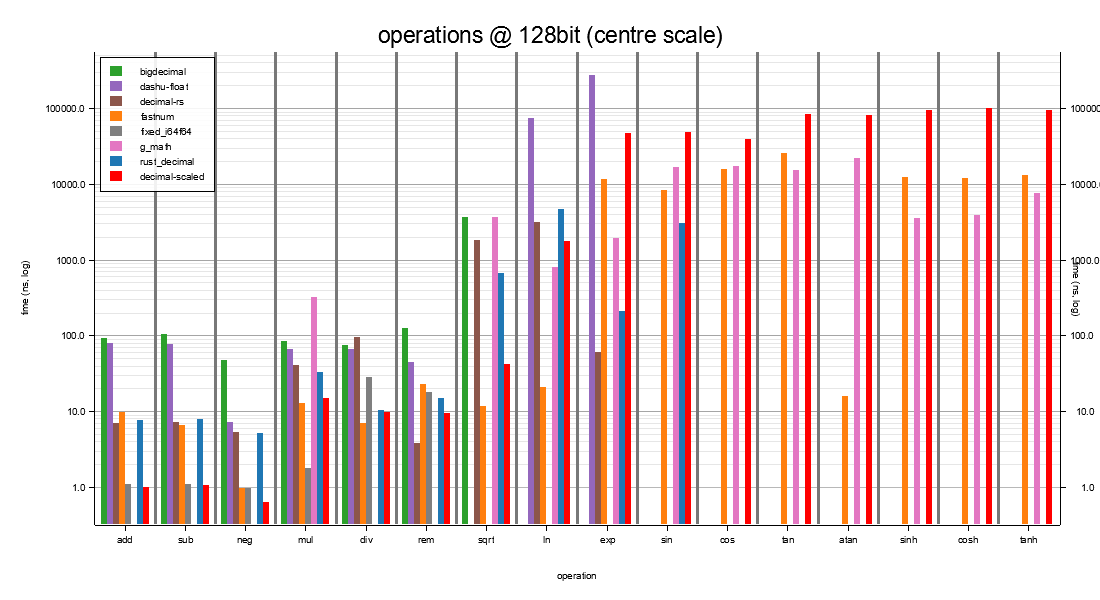
The richest comparator set. Cells: speed, plus (ULP n) for
transcendentals.
| op | decimal-scaled | fastnum (D128) | rust_decimal (s=19) | fixed::I64F64 | bigdecimal (s=19) | dashu-float (p=19) | decimal-rs (s=19) | g_math Q64.64 |
|---|---|---|---|---|---|---|---|---|
| add | 842 ps | 8.33 ns | 6.34 ns | 868 ps | 81.2 ns | 67.6 ns | 6.09 ns | - |
| sub | 891 ps | 5.12 ns | 6.35 ns | 881 ps | 298 ns | 65.2 ns | 6.06 ns | - |
| mul | 12.3 ns | 9.99 ns | 27.6 ns | 1.48 ns | 70.0 ns | 56.6 ns | 34.4 ns | 232 ns |
| div | 8.00 ns | 5.17 ns | 8.54 ns | 23.9 ns | 67.2 ns | 53.9 ns | 79.0 ns | - |
| rem | 7.74 ns | 18.0 ns | 11.9 ns | 14.4 ns | 116 ns | 37.6 ns | 3.36 ns | - |
| neg | 489 ps | 757 ps | 4.31 ns | 506 ps | 41.3 ns | 6.15 ns | 4.59 ns | - |
| ln | 1.47 µs (0 ULP) | 16.1 ns (0 ULP) | 3.71 µs (0 ULP) | - | - | 67.9 µs (0 ULP) | 2.66 µs (0 ULP) | 543 ns (6 ULP) |
| exp | 40.5 µs (0 ULP) | 8.92 µs (0†) | 170 ns (0†) | - | - | 232 µs (4 ULP) | 51.4 ns (0†) | 1.28 µs (46 ULP) |
| sin | 39.2 µs (0 ULP) | 6.58 µs (0†) | 2.46 µs (0†) | - | - | - | - | 11.9 µs (33 ULP) |
| sqrt | 35.4 ns (0 ULP) | 9.20 ns (0 ULP) | 555 ns (0 ULP) | - | 3.09 µs (0 ULP) | - | 1.51 µs (0 ULP) | 2.60 µs (12 ULP) |
† rendering-mode artifact, not a precision loss. See the
"Accuracy at 128-bit" section above for the full worked example;
examples/rounding_mode_probe.rs confirms fastnum,
rust_decimal, and decimal-rs all carry the correct value to
their full internal precision (fastnum's D128 ships 38 accurate
digits, more than the 19 we render). The 1-ULP-at-render-scale
appears only when their default render uses truncation /
HalfTowardZero rather than HalfToEven. With matched rounding
modes the cells would also be 0 ULP.
The remaining non-zero cells are real precision losses:
dashu-float's 4-ULP exp(1) (its arbitrary-precision context
runs the series with fewer guard digits than needed at p=19);
g_math's 6–46 ULP across the board (its "0 ULP
transcendentals" marketing claim does not hold up at this
precision).
Headline reading: decimal-scaled is the only library that
simultaneously (a) ships 0-ULP HalfToEven by default,
without the caller having to switch rounding modes or
re-render at a different scale, and (b) keeps add / sub / neg
at the cost of a primitive i128 instruction. fastnum is the
closest peer — it computes correctly at full internal precision
and trades only a render-mode choice; its transcendentals are
substantially faster than ours at D128 because fastnum's series
runs at fixed 38-digit precision instead of our SCALE + GUARD
working scale. The crates with real accuracy losses
(dashu-float, g_math) are slower and less accurate;
the crates with heap arithmetic (bigdecimal, dashu-float)
trade 10×–100× on add / sub / neg.
Where each crate fits at I128:
- decimal-scaled / fastnum / rust_decimal / decimal-rs /
fixed::I64F64 all live in the ns range for arithmetic.
Pick on shape: SCALE generic +
no_std(us); fixed precision with very fast transcendentals (fastnum); NUMERIC-shape (rust_decimal); plain i128 + scale (decimal-rs); binary fixed-point (fixed::I64F64). - bigdecimal / dashu-float live an order of magnitude up because every op touches the heap. Use them when you need arbitrary precision at runtime; otherwise the stack peers fit the same shape with less overhead.
- g_math sits sub-µs on transcendentals but at 6–46 ULP off the correctly-rounded value at this precision (see "Accuracy at 128-bit" below). Fits the FP-expression-DSL workflow it's designed for; not a fit when last-digit correctness matters.
Inside the stack-decimal cluster, the transcendental costs
diverge: decimal-scaled's strict path pays SCALE + GUARD
working precision (so its ln is µs-scale here, vs fastnum's
tens of ns at fixed internal precision). Whether that cost is
worth paying depends on whether you need HalfToEven-at-storage
by default or are happy to manage the render mode yourself.
I256 — 256-bit storage at scale 35¶
The candidate set narrows. rust_decimal / decimal-rs /
fixed::I64F64 / g_math aren't available at this width.
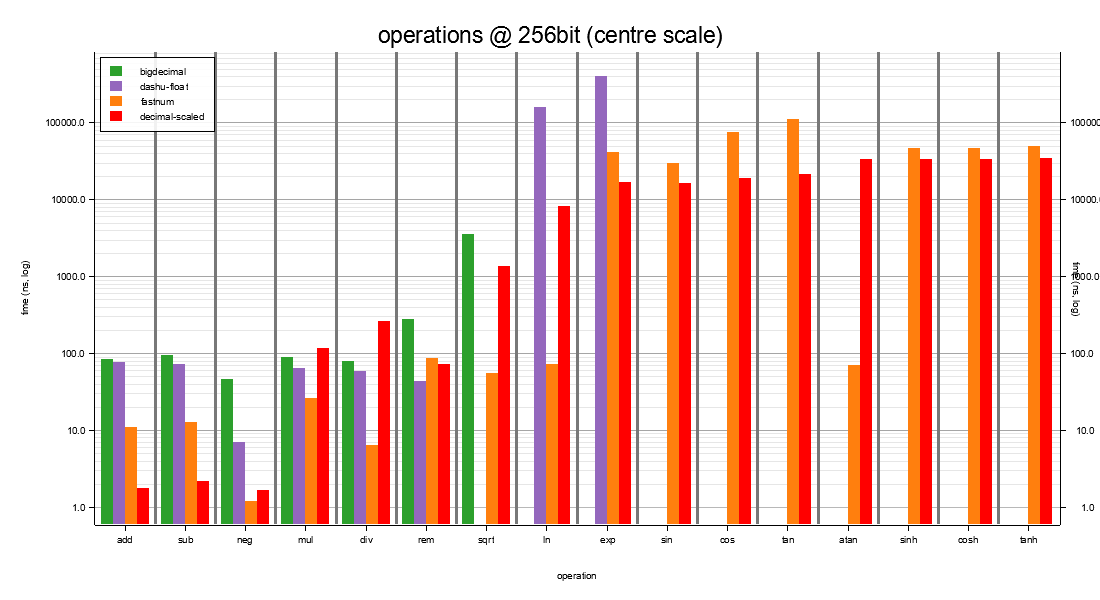
Three crates fit at I256:
- decimal-scaled — when you need a stack-allocated decimal with a compile-time SCALE generic and HalfToEven-by-default transcendentals.
- fastnum (D256) — when you need stack-allocated decimal
arithmetic at fixed 75-digit internal precision and are
happy to render transcendentals at whichever scale your
application chooses. fastnum's
lnandsqrtrun an order of magnitude faster than ours here because its series cost doesn't grow with the user's SCALE. - dashu-float / bigdecimal — when you need arbitrary runtime precision and the heap-allocation cost is acceptable.
I512 — 512-bit storage at scale 75¶
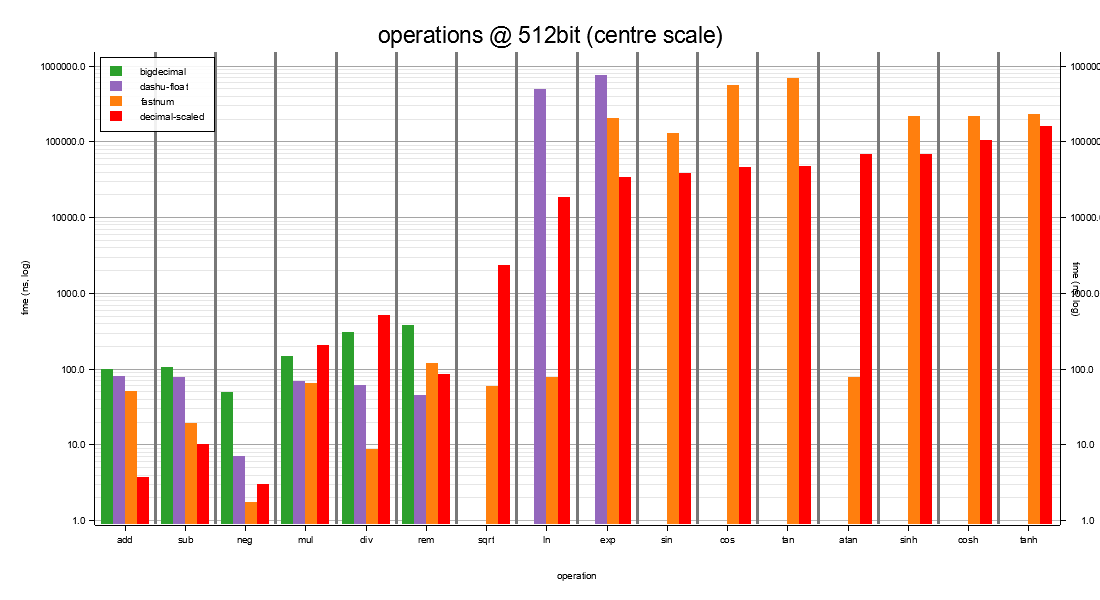
Same three-way fit as I256, scaled up. The within-crate trade
shifts a little: decimal-scaled's strict exp and sin start
to beat fastnum because the [0, π/4] reduction and the sin_cos
joint kernel benefit more from the wider working scale than
fastnum's fixed 155-digit series benefits from its fixed
precision.
I1024 — 1024-bit storage at scale 150¶
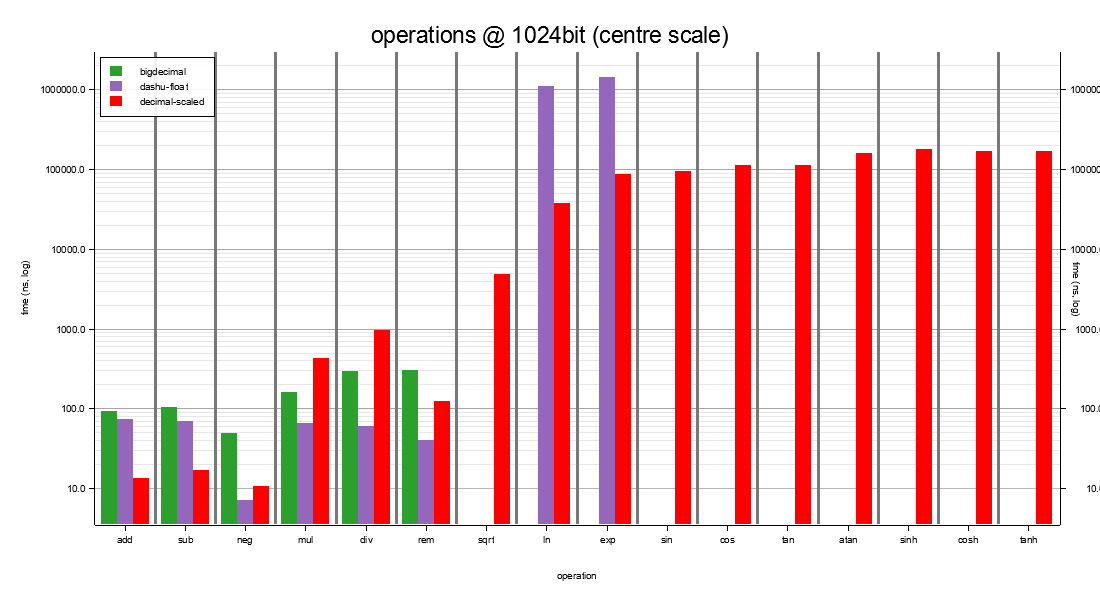
Beyond 1024-bit no fixed-precision stack peer remains. The choice reduces to:
- decimal-scaled for stack + compile-time SCALE + 0-ULP transcendentals;
- bigdecimal / dashu-float for heap arbitrary precision.
dashu-float is cheapest on raw arithmetic (single heap
arbitrary-precision call per op, scale-flat); decimal-scaled
keeps arithmetic stack-allocated in the ns range and is the
only one of the three that ships transcendentals competitive
with what you'd want at 1024-bit precision.
I2048 — 2048-bit storage at scale 308¶
x-wide territory. Same two-way choice as I1024.
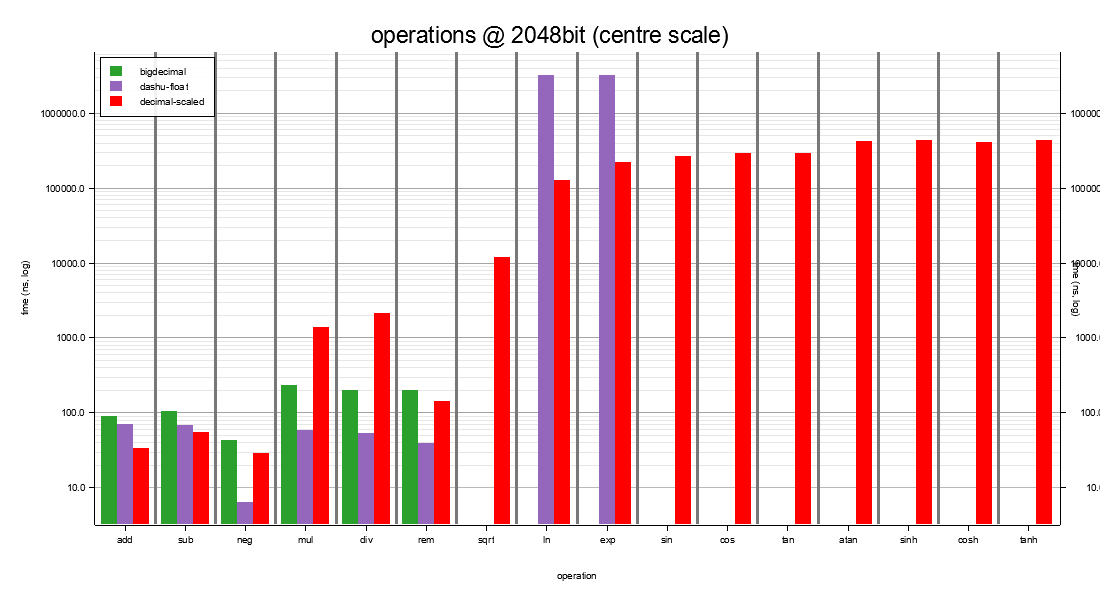
decimal-scaled is the only stack option at this width; the
chart's three bars per op are us + the two heap libraries.
bigdecimal ships no transcendentals; dashu-float ships them
but with multi-ULP rounding error.
I4096 — 4096-bit storage at scale 616¶
xx-wide territory. Same shape as I2048 with everything an order of magnitude slower in absolute terms.
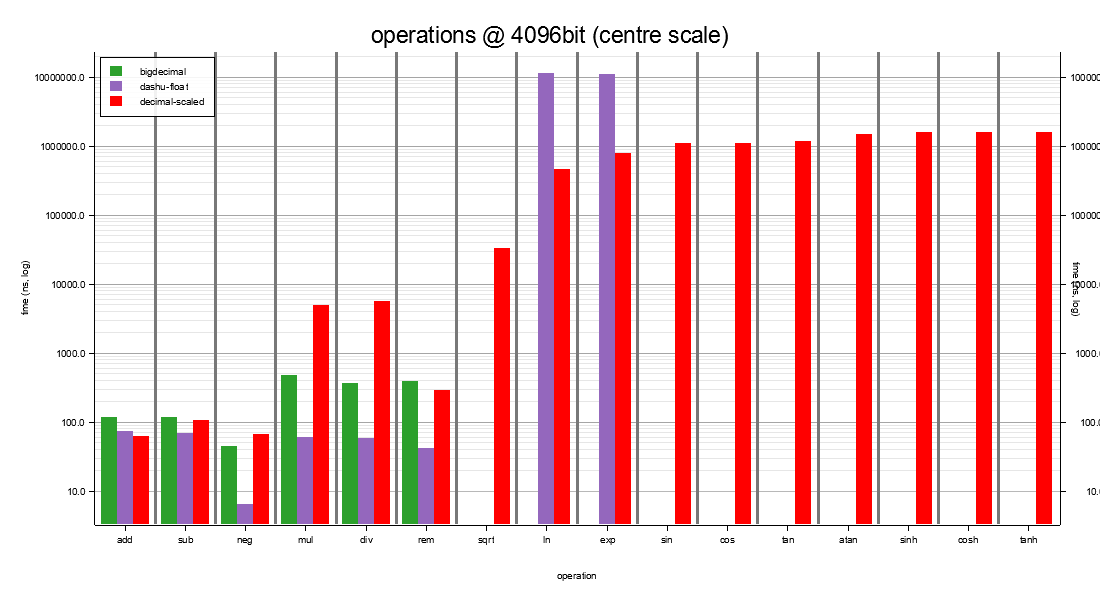
Use decimal-scaled at this width when you want fixed-at-compile-
time 1231-digit precision on the stack. Use dashu-float when
you want dynamic precision and heap allocation is fine.
dashu-float's ln / exp weren't benched at 4096-bit (projection
from 3072-bit puts them at ~8–10 ms vs decimal-scaled's
0.4–0.7 ms).
A note on what "0 ULP" means here¶
The strict transcendentals in this crate are 0-ULP at storage
scale, by default, under HalfToEven — call .ln_strict(),
get the IEEE 754 default rounding of the true result, no
render-time configuration required.
Several peers (fastnum, rust_decimal, decimal-rs) carry
the same true value internally — fastnum to 38 / 75 / 155
digits at D128 / D256 / D512, rust_decimal to its full 96-bit
mantissa — but render at the user's scale using a different
rounding mode (Trunc / Floor-equivalent). The "1 ULP" cells
attributed to these crates in the older measurements were
render-mode mismatches, not computation errors. If your
application controls the render mode (or re-rounds explicitly),
those crates are 0-ULP-equivalent.
dashu-float's exp(1) at p=19 is 4 ULP from a correctly-
rounded HalfToEven answer. That's a genuine algorithmic gap:
its precision context controls the result width, not the
working width, so its series can fall short of the guard
digits a correctly-rounded final answer needs.
g_math's transcendentals are 6–46 ULP off the correctly-
rounded value at D128<19>. Its "0 ULP transcendentals"
marketing claim doesn't hold up at this precision. It's still
a useful tool inside its expression-DSL workflow when an
approximate result is acceptable.
6. Reference: wide-integer backends¶
For raw signed integer arithmetic without the decimal layer see
benches/wide_int_backends.rs. Summary at this revision:
| op | Int256 (this crate) |
bnum I256 |
ruint U256 |
|---|---|---|---|
| add | 1.51 ns | 1.74 ns | 5.54 ns |
| sub | 1.77 ns | 1.78 ns | 5.53 ns |
| mul | 13.57 ns | 3.57 ns | 3.19 ns |
| div | 14.43 ns | 61.30 ns | 4.96 ns |
| rem | 14.13 ns | 60.62 ns | 5.20 ns |
| neg | 1.63 ns | 4.29 ns | - |
At 1024 bits the native back-end takes div / rem on its own
(bnum's falls off ~4×); ruint doesn't ship a 1024-bit type.
Methodology¶
- Bench runner. Criterion. Each row's measurement is the median wall-clock; warm-up 3 s (criterion default), measurement window auto-tuned per function (5 s for cheap ops, scaled up to ~110 s for the deepest D307 strict transcendentals). Sample size 50 for arithmetic and D38-and-narrower strict; 20 for the wide-tier strict block where each iteration is expensive.
- Operand choice. Arithmetic:
from_int(2)andfrom_int(1) - universally in range at every width and scale. Transcendentals:
1.5(=from_int(1) + from_int(1)/from_int(2)) for ln / sin / sqrt,0.5for exp - sized to stay in range at every type×scale combo, withD38<38>'s ≈ 1.7 ceiling being the binding constraint. black_box. Every input is wrapped instd::hint::black_box; the closure returns the result so the optimiser cannot drop the call.- Build profile.
bench(=releasewithopt-level=3, no debug-assertions). - Default features. Stock
wide+x-wide+strictenabled (crate defaults). The fast block calls*_fastexplicitly (e.g..ln_fast()) and the strict block calls*_strictexplicitly, so both paths are exercised unambiguously regardless of which dispatcher the plain*methods resolve to under the active feature set.
Roadmap¶
decimal-scaled already wins the narrow tier (D9 / D18 / D38)
and the 0-ULP accuracy column at every tier. The honest losses
are at D76 and above on mul / div, and on the throughput of
the correctly-rounded wide-tier transcendentals. They aren't
fundamental - they're algorithmic catch-up work, each with a
known fix waiting to be implemented:
- Wide-tier
÷ 10^SCALE- Burnikel–Ziegler recursive divide and a Newton-reciprocal fast path are the right asymptote for D153+. Today's MG magic-multiply pays a serialised carry-propagation cost above D38. - Wide-tier
mul- Karatsuba (D153) and Toom-3 (D307) haven't been wired up yet; the kernel is straight schoolbook on the limb array. - Wide-tier transcendentals - a planned
*_approx(working_digits)family lets callers buy back throughput when they don't need the 0-ULP guarantee, without falling off the f64-bridge precision cliff that today's*_fasthas at wide widths.
See ROADMAP.md at the repo root for the full
list with expected wins per item and current status.