Architecture¶
This page is a map of how decimal-scaled is put together: the two
layers (integer backends and decimal front-ends), how a method
call is routed to one specific algorithm with zero runtime dispatch,
how unused algorithm variants are pruned at compile time, and how the
correctness and performance guarantees are enforced by testing.
The model in one sentence¶
Every value is a plain integer that encodes real_value × 10^SCALE. All
core arithmetic is integer arithmetic, so results are bit-identical on
every platform, and the transcendental functions are computed with
integer-only kernels that are correctly rounded — within 0.5 ULP of
the true real value at the type's last representable place.
Two absolute invariants: no heap, no state¶
These two rules sit above everything else on this page. They are not performance preferences or style choices — they are the load-bearing guarantees the whole design rests on, and no benchmark, no convenience, and no algorithm is permitted to break them.
-
No heap — the runtime path is pure stack. No
Vec,Box,Rc,Arc,alloc::*, or any heap allocation anywhere a value is computed. Every working buffer is an inline[u64; …]/[u128; …]on the stack, sized at compile time (theComputeLimbsassociated-type buffers on theLimbs<N>carrier and const-initstaticdata are how a width wider thanNis carried — see Work-width scratch below). This is what lets the crate run inno_stdwith no allocator and keeps every call's cost on the stack where it const-folds. A heap allocation on the compute path is a hard defect, never a tolerated one. (The earlier heap exceptions — adecl_table_cache!Vectables macro and thenewton_reciprocalthread_local!+Veccache — were removed;_wide-support = []is now a heap-free marker. Do not reintroduce any of them.) -
No state — thread-safety comes from being stateless, so there is NO cache whatsoever. Every function is a pure function of its inputs and recomputes on each call. No
thread_local!, nostatic mut, no interior-mutability cache slot (RefCell/Cell/Mutex/OnceCell-as- cache/atomics-as-cache), no memoization across calls — anywhere on the runtime path. The crate isSend/Sync/re-entrant for free because no call carries mutable state between invocations; introducing a cache would trade that guarantee for a speed-up we refuse to make.
The line is MUTABILITY, not whether something is global. An immutable
static is ALLOWED — it is the sanctioned form for compile-time-baked
read-only data (e.g. the per-scale constant tables), and reading it at a
runtime index is a lookup, not a recompute and not state. A static mut,
or a static made mutable through interior mutability, is a singleton and
is BANNED. Concretely:
- ✅
static FOO: [u64; N] = …/const FOO: … = …— immutable, compile-time, read-only data (the per-scale constant + Tang tables). - ❌
static mut FOO— a mutable singleton. - ❌ any
staticwhose contents change at run time —OnceCell/OnceLock/Mutex/RwLock/RefCell/Cell/ atomics used as a cache or accumulator (interior mutability as a singleton / memo). - ❌ heap on the compute path —
Vec/Box/Rc/Arc/alloc::*.
The dividing line is WHEN the value is produced, not whether it is
stored. Compile-time precomputed data is fine and encouraged: a
const / const fn / static table baked into the binary by the
compiler is immutable read-only data — it is computed once at build time,
never written at run time, and shared with no synchronisation. What is
forbidden is a value computed/populated at run time on first use and
kept for later calls — that is memoization. That is what a
NewtonReciprocal precompute cache or the pi/ln2/ln10/pow10
thread_local! caches WOULD do; they were removed and must not return.
The fix for such a site is either (a) lift the
precompute to compile time (a const/const fn table) where the value
is fixed, or (b) recompute it each call on the stack; it is never
to relocate the runtime cache into a mutable static.
Where a runtime computation genuinely IS needed, minimise it to the cases
that need it — const-fold the common path, never recompute on the hot path,
and never blanket-remove the runtime path when a rare case legitimately
needs it. Many values are const-derivable for the common case yet
runtime-varying in a rare one. Example: pi/ln2/ln10 are fixed at the
common working scale w = SCALE + GUARD — a compile-time const per
(width, SCALE) const-folded off the propagated SCALE — but a rare
directed-rounding / Ziv guard escalation genuinely needs them at a higher,
runtime-varying scale. The rule: bake the common case (the hot path then
never recomputes — recalculating pi on every call is the anti-pattern) and
keep the runtime recompute ONLY for the rare case that provably cannot be
const. A runtime input such as a working scale w may stay a runtime value
where it genuinely varies — the goal is not to delete the runtime parameter
but to stop deriving the const-derivable value from it on the hot path. The
bar (enforce it in review): a runtime recomputation is retained only at sites
where a SCALE/GUARD-derived const provably cannot stand in — and only
there.
Together these mean the answer to "make this faster with a cache/buffer
pool" is always no: the speed comes from a better generic kernel,
const-folding, and exact-per-N stack scratch — never from heap or state.
Two layers, same shape¶
The crate is two layers that mirror each other — a decimal layer on top of an integer layer. Each has the same three tiers: a typed surface, a const-folded width dispatch, and an algorithm library. A decimal kernel expresses its math in integer operations and never reaches into limb internals directly.
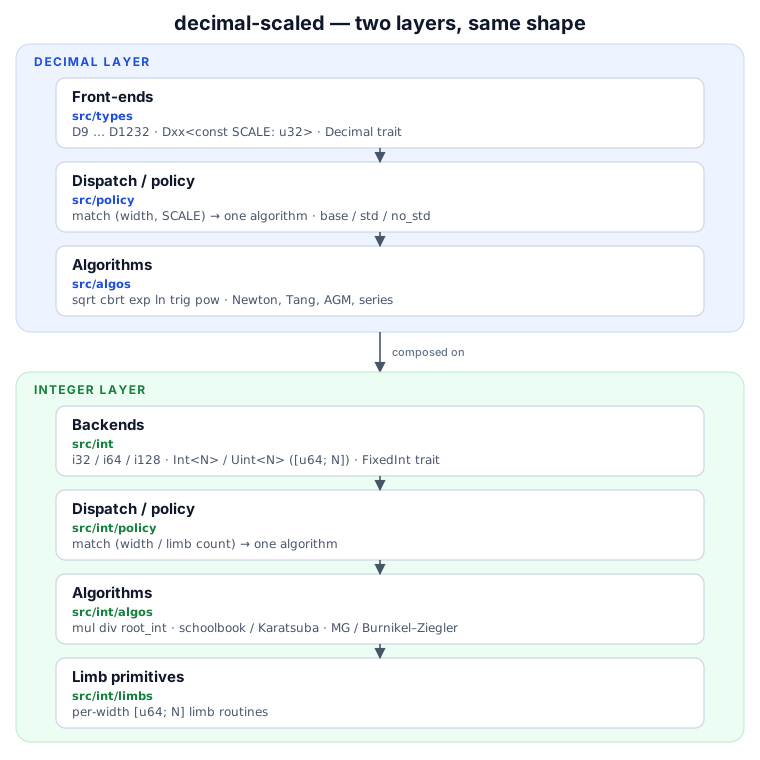
The key point the older sketch hid: the integer layer is not just
primitives — it has its own dispatch policy and algorithm library,
mirroring the decimal layer. A BigInt method (mul, div,
root_int, …) routes on the compile-time width / limb count to one
matched algorithm — schoolbook below the Karatsuba threshold and the
non-allocating Karatsuba above it, Möller–Granlund divide at the narrow
tiers and Burnikel–Ziegler at the wide ones — and the compiler prunes
the rest, exactly as the decimal policy keys on (width, SCALE). Both
layers compile to a single direct call per monomorphisation.
A call through the layers¶
D57<20>::sqrt_strict() traverses both layers' dispatch + kernels:
the front-end dispatches on (width, SCALE) to one decimal algorithm, which
calls the integer layer — itself dispatching on width to a matched
algorithm down to the limb primitives — and hands back a
correctly-rounded raw value.
sequenceDiagram
  autonumber
  participant U as caller
  participant FE as D57 front-end
  participant DP as decimal policy
  participant DK as sqrt algorithm
  participant IP as int policy
  participant IK as int algorithm
  participant L as limb primitives
  U->>FE: sqrt_strict()
  FE->>DP: dispatch (width 192, SCALE 20)
  DP->>DK: const select → matched algorithm
  DK->>IP: root_int / isqrt on Int<3> (BigInt)
  IP->>IK: const-folded → width-matched isqrt
  IK->>L: limb ops on [u64; 3]
  L-->>IK: limbs
  IK-->>DK: integer root + residual
  DK-->>FE: correctly-rounded raw
  FE-->>U: D57 value
Integer backends¶
The storage under a decimal type is an integer wide enough to hold
10^MAX_SCALE:
| Decimal tier | Storage |
|---|---|
| D18 / D38 | Int<1> / Int<2> |
| D57 … D1232 | Int<3> … Int<64> |
Every tier is built on a single const-generic pair —
Uint<const N: usize> and Int<const N: usize> — stored as [u64; N]
little-endian limbs (N = number of 64-bit limbs; bit width is N·64).
Choosing the limb count as the one type parameter sidesteps the
LIMBS = ⌈BITS/64⌉ derivation that a bits-parameterised type cannot
express on stable Rust.
The arithmetic itself lives once, as reusable width-matched limb
algorithms (add/sub/mul/div/shift/compare, plus sqr, cube,
root_int, isqrt, …) operating over &[u64] slices. Because N is a
compile-time constant, the limb loops unroll per width and there is no
runtime length to carry. A BigInt trait exposes this surface with the
same method names as the decimal arithmetic trait, so the two layers
read as one vocabulary.
src/:
int/                const-generic integer layer
  types/            Int<N>/Uint<N>; the BigInt trait; the Limbs<N> scratch
                    carrier + ComputeLimbs (compute_limbs.rs)
  policy/           per-width / limb-count algorithm-selection dispatch
  algos/            reusable width-matched algorithms
    support/limbs.rs  raw slice limb primitives
Decimal front-ends¶
Each width is a Dxx<const SCALE: u32> newtype around its storage
integer. The number in the name is MAX_SCALE (the largest SCALE the
storage can hold); SCALE is a const-generic so D38<2> (cents) and
D38<18> are distinct, zero-overhead types. Because a value has exactly
one representation at a fixed scale, Eq/Ord/Hash are derived
straight from the storage bits.
The cross-width API is four trait families (src/types/traits/):
DecimalArithmetic— operators, sign, integer methods, the checked/wrapping/saturating/overflowing families, reductions.DecimalConvert— round-trip, integer and float bridges.DecimalTranscendental—sqrt/cbrt/exp/ln/trig/hyperbolic/pow.DecimalConstants— the per-type math constants (pi,e, … ).
Decimal is the marker supertrait combining the four. Two more traits
sit alongside them: WidthLE (the compile-time width-ordering relation
used by the widen / narrow hops) and, under the dyn feature,
DynDecimal (the object-safe erased view).
The typed method shells (D57::<20>::sqrt_strict_with(mode)) are emitted
by macros in src/macros/ and immediately hand off to the dispatch layer.
Work-width scratch — exact ComputeLimbs on the Limbs<N> carrier, never build-max¶
Many algorithms compute in a width wider than the value's own N u64
limbs: a multiply's 2N product, a sqrt radicand (2N), a cbrt
radicand (4N), the ÷10^w magnitude (⌈N/2⌉ u128). Stable Rust cannot
name [u64; 2N] from a generic N, so the width lives on an
associated-type buffer. That buffer is NOT a capability of the value
integer; it is carried by a separate zero-sized limb carrier,
Limbs<const N> — the Limb / Limbs<N> / ComputeLimbs triad:
Limb— the scalar element axis (u64/u128); a width-generic kernel's per-element type (see Limb width below).Limbs<N>— the zero-sized sizing marker (never instantiated), one perN-u64-limb width. It is the type theComputeLimbsbuffers hang off.ComputeLimbs— the trait carrying the per-Nbuffer associated types- constructors (
src/int/types/compute_limbs.rs), implemented forLimbs<N>(NOT forInt<N>). It has no supertrait — a pure sizing capability, deliberately not: BigInt.
The value integer names its carrier through the BigInt::Scratch
associated type (type Scratch = Limbs<N> in impl BigInt for Int<N>,
src/int/types/traits.rs) — the sanctioned surface: the value integer
merely names its scratch carrier, it does not carry the scratch. This
avoids a supertrait cycle: if scratch were instead a capability on the
integer bounded : BigInt (the rejected shape, which is what the trait was
called — ComputeInt — before it moved to the Limbs<N> carrier), a blanket
BigInt method (or Int<N> operator) could not require that capability
without a cycle.
ComputeLimbs does not require BigInt, and BigInt only names its
carrier, so:
- a concrete-
Nkernel bounds onLimbs<N>: ComputeLimbs, callsLimbs::<N>::double_buffered_u64(), and gets an exactly-sized stack buffer that folds away per monomorphisation; - a kernel generic over a value integer
W: BigIntreaches scratch asW::Scratch::single_u128()under awhere W::Scratch: ComputeLimbsbound, with no scratch bound onWitself.
BigInt::Scratch is declared unbounded (type Scratch;, no
: ComputeLimbs). BigInt is a blanket impl<const N> for every Int<N>,
but in the exact-scratch build ComputeLimbs is implemented only at the
listed widths; a type Scratch: ComputeLimbs bound would be unprovable for
an arbitrary blanket N. The ComputeLimbs requirement is therefore
discharged at the generic-helper use sites (where W::Scratch:
ComputeLimbs), where W is always a concrete width that has it. (Limbs<N>
is declared pub only because it is named in the pub BigInt::Scratch
type — E0446 forbids leaking a more-private type — but it lives in the
private int module, so it is not crate-public API, exactly like the pub
struct Int<N> value type beside it.)
The scratch vocabulary is fixed clean limb-multiples — two families. A
buffer is named by a multiple of N, never by the function that wants it
(no LimbBufDivU128-style per-function type). Two families, each available
in both u64 and u128 element form:
- Plain
X·Nmultiples —single(N),double(2N),quad(4N). The exact value/product width. - Buffered variants (a fixed
⌈N/2⌉of headroom for normalisation / carry / packing) —single_buffered(N + 2),double_buffered(2N + ⌈N/2⌉≈ 2.5N),quad_buffered(4N + ⌈N/2⌉≈ 4.5N).
Adding a higher multiple is expected, not exceptional — an algorithm
that needs, say, an 8N buffer adds one size axis the same way (a literal
in each build-form impl, an associated type per element, and the Limb
forwarder). There is nothing privileged about 1×/2×/4×.
Why these are methods, not a const expression: stable Rust, no nightly.
The clean way to write [u64; 2N + ⌈N/2⌉] from a generic N would be
generic_const_exprs — a nightly feature. Rather than pin the crate to
nightly, each concrete-N impl simply states the exact computed size for
that width (the per-N macro emits [u64; 2 * $n + ($n + 1) / 2], etc.).
So the method is the const-expression workaround: it hands back the
exact maximum for that one width, computed at the impl, with no nightly
feature and no signature-level const. (If generic_const_exprs ever
stabilises, these collapse to inline array sizes — the method surface is the
stable-Rust stand-in for that, not a permanent design preference.)
The algorithm sources its own exact scratch. A kernel that needs a
wider width takes where Limbs<N>: ComputeLimbs and calls the normal
per-N method (Limbs::<N>::double_buffered_u64(), …); a value-generic
helper takes where W::Scratch: ComputeLimbs and calls
W::Scratch::single_u128(). It must not pass a work width as a
const-generic argument (fn f<W, const LW: usize> where LW == W::U128_LIMBS
is a defect — that const-work-width parameter is exactly the wall
ComputeLimbs exists to remove), and it must not reach for the build-max
blanket.
The build-max blanket is the fallback of last resort — NOT for
algorithms. MAX_SINGLE_LIMBS / MAX_DOUBLE_LIMBS / MAX_QUADRUPLE_LIMBS
/ MAX_U128_LIMB (and the max_*_limbs() constructors), feature-gated via
MAX_WORK_N, are sized to the widest tier the build enables. They exist for
the few paths that structurally cannot carry a concrete N on stable —
the width-erased ones, blanket over every N:
- the blanket
Int<N>//%operators and the width-erased blanketBigIntmethods (resize_to). TheBigInt::Scratchbridge no longer cycles (a blanketBigIntmethod could now nameSelf::Scratch::*underwhere Self::Scratch: ComputeLimbs) — butresize_tois invoked on a generic receiverInt<N>(theraw.resize_to::<Int<N>>()policy bridges), and a generic-Ncaller cannot dischargeLimbs<N>: ComputeLimbsin the per-widthexact-scratchbuild, so the bound would cascade unboundedly. These stay build-max. - the width-erased slice-divide engines (
div_knuth,div_burnikel_ziegler_with_knuth,div_knuth_u128_limb) — they take a bare&[u64]of runtime length by design; there is noNto size against.
The bare operators are also cold — decimal ops route through the
ComputeLimbs kernels, not the Int<N> operator — so the build-max blanket
is a shrinking fallback whose target is zero.
Paths that look like exceptions but are not — a concrete N or const
SCALE is in scope, so they must use ComputeLimbs:
Display/ radix formatting (int_fmt):Nis the monomorphised width atimpl<const N> Display for Int<N>, andfmt_into::<N>(&[u64], …)now carries that constN(boundedLimbs<N>: ComputeLimbs). Both its limb scratch (Limbs::<N>::single_u64()) and the caller's byte-output buffer (digit_formatting_limbs_u8(),20N + 2bytes) are sized exactly per-N— no build-max here.newton_reciprocal: its reciprocal/pow buffer lengths are functions of the work width and the divide exponent, and the exponent derives from the constSCALEthat the decimal policy dispatch carries (keyed on(const N, const SCALE), the channel that should thread it). Both axes are const-provided, so these buffers are a const-sizing target — today frozenMAX_*_U64literals fed a runtimescale: u32, a Class-B defect to size down per(width, SCALE)threaded from dispatch.widen_mul, the Newton-rootseed_bridge, every algorithm kernel: concreteN→Limbs<N>: ComputeLimbs; value-genericW→W::Scratch: ComputeLimbs.
Everywhere a concrete N is in scope — every algorithm kernel, every
decimal policy and decimal kernel — use the normal ComputeLimbs methods,
never a MAX_* variant. A MAX_* / max_*_limbs() use on a concrete-N
path is the build-max blanket leaking onto a tier that can size itself
exactly: that is the cross-tier size pollution the Constitution (rule 6)
forbids, and it is a defect to be migrated to Limbs::<N>::single_u64() /
double_buffered_u64() / quad_buffered_u64() / single_u128().
The build-max divide bound — when the slice engines' blanket is reachable¶
The width-erased slice engines above are the one sanctioned build-max scratch,
but "no N to size against" is not the same as "unbounded". Their buffer has a
reachable limit, and crossing it is what produced #86 (asinh panicking at
D924/D1232).
Exposed ⟺ any non-
Remverdict reaches the blanket door with an effective dividend exceedingMAX_SINGLE_LIMBS - 2.The narrower shape that actually panicked (#86): the divisor even with ≥ 24 limbs and
num_m >= 2 * den_n— which is whenselect_for_limbsreturnsAlgorithm::KnuthU128Limb. Worth keeping in view, because a reader tracing that panic will look for it; but it selects an ARM, it does not bound the hazard.
The - 2 is div_knuth_into's own stated requirement: u must be at least
num.len() + 2 limbs, because the divide reads one limb above the live
dividend and relies on the zero there.
MAX_SINGLE_LIMBS = 4 * MAX_WORK_N + 2: 258 (xx-wide), 130 (x-wide),
66 (wide), 10 (narrow default).
Stating it as a rule rather than a list of call sites buys three things:
- It is checkable against a new call site without re-deriving anything. The
ceiling belongs to the DOOR, not to one arm: both Knuth arms reach a
build-max buffer.
div_knuth_u128_limbhas its[0u64; MAX_SINGLE_LIMBS], and the plaindiv_knuthblanket door allocates twomax_single_limbs()buffers of its own (div_knuth.rs:26-30) before delegating todiv_knuth_into. So the plain-Knuth arm shares the same effective-dividend ceiling, guarded only by adebug_assert!atdiv_knuth.rs:76— compiled out of release — and the release slice bounds-check behind it. - It explains why the failure panics rather than corrupting. The bound is
value-derived, not type-derived, on both arms.
div_knuth_intostrips BOTH operands to their effective lengths before touchinguorv(div_knuth.rs:55-71), anddiv_knuth_u128_limb_intostrips totop64then writesu64buf[top64] = carry— a real bounds-checked index. An operand wide by type but small by value is therefore fine, which is most of why a ceiling this low is met so rarely. - It shows the single-limb-divisor cases are unreachable by routing, not by
luck. A one-limb divisor returns
Algorithm::Rembefore Knuth is ever considered, so/ lit(2),/ lit(M),/ lit(2j+1)and/ jcannot reach the blanket at any width.
Measured, not guaranteed — 2026-09-01. A sweep of this branch's paths found
no reachable shape presenting 256 or more effective dividend limbs through the
blanket door; the largest is about 75 limbs, from ln_tang's / 10^w_ext.
That is a measurement of today's call sites, not a property of the code. A new
caller, or a wider Wexp/Wagm pairing, moves it without anything complaining
— which is exactly the gap The durable fix below is meant to close.
This section's own rule was an instance of what it warns about. It read
"div_knuth has no such array" — a confident claim about where a hazard cannot
reach, which is the shape the section exists to catch. The conclusion held (the
ceiling is real, and #86 was its instance) while the stated reason was wrong.
That is worth more than the correction: a claim carries no warrant just because
it sits next to the analysis it qualifies, and the rules here are the ones most
likely to be trusted unread.
The Int<512> knife-edge. exp_fixed_tagged instantiates
expm1_fixed_tagged at C::Wexp, which is Int<512> at D1232. Its one
multi-limb-divisor divide is round_div_pow10(prod, w), where prod ~ 10^(2w)
is about 131 limbs against a 66-limb 10^w. The u128 arm needs
num_m >= 2 * den_n = 132. It misses by one limb. Two independent reasons
keep it safe — that, and routing through the guarded rescale rather than the
raw operator — but a one-limb margin is not a safety property; it is a
coincidence that survives until w shifts the rounding of limbs(10^(2w)) up
by one. And 131 sits only 65 under the wide blanket's 66: safe at
xx-wide, marginal in a narrower MAX_WORK_N build.
The root cause, once. MAX_WORK_N is scoped to storage-derived widths,
while Wexp and Wagm are chosen independently of it — D1232 pairs Int<64>
storage with Int<512> Wexp and Int<256> Wagm. Any blanket engine sized
from MAX_WORK_N can therefore meet an operand it cannot hold, and no gate
catches it because every gate pairs the wide flags, so the blanket path is
never fed an over-long operand.
#87 is the same family on the multiply side. mul_karatsuba's build-max
scratch fits the widest work integer with exactly zero margin
(KARATSUBA_MAX_WIDTH = 256 against Wagm = Int<256>), and its overflow guard
is a debug_assert! compiled out of release. What that costs is the
diagnostic, not the safety: karatsuba_rec splits its scratch with
split_at_mut, which panics when the index exceeds the slice, so an undersized
scratch still aborts rather than corrupting. In release the failure is a bare
slice panic instead of the assert's message naming n, needed and available.
Both #86 and #87 therefore fail loudly; #87 just fails less legibly.
The durable fix is for the blanket engines to take their scratch from
ComputeLimbs, as div_rem_exact already does — the shape bracket_div uses
(matcher verdict via select_for_limbs, then the engine's _into door with
ComputeLimbs scratch, checking num.len() + 2 and returning None on a
shortfall) generalised to dispatch itself. That removes the hazard rather
than documenting it, and means no future caller needs a reachability audit.
Scope: audited at dfc4302f. adjust_alternating_bracket, added since, was
verified separately at the feature tip. Not a tip-wide sweep.
Proposed, NOT ruled on — how dispatch could take exact scratch¶
The tension. dispatch cannot simply gain a where Limbs<N>: ComputeLimbs
bound, because it has no N: it exists to serve width-erased &[u64] callers
of runtime length. But that erasure is mostly inherited, not required — the
overwhelming majority of traffic arrives through div_rem_mag_fixed<const N>,
which has N in scope and throws it away at the call. Only two callers are
genuinely N-less: mul_schoolbook and newton_reciprocal, both via
div_rem_mag_slice.
Shape (recommended): split the door, keep the blanket hard-guarded.
dispatch_into(num, den, quot, rem, u64buf, v64buf, u128buf…)— the real implementation, scratch supplied by the caller.div_rem_mag_fixed<N>sources those fromLimbs<N>and calls it. This is where #86 came from — the transcendental kernels reach the blanket throughInt<N>operators — so fixing this arm alone removes the whole observed hazard class.dispatch(...)stays for the two genuinelyN-less callers, keeps the build-max buffer, and gains the guard it lacks today: checkeffective_limbs(num) + 2 <= MAX_SINGLE_LIMBSand fall back to an engine needing no oversized scratch, rather than indexing past the buffer.
Why not the alternatives. Bound dispatch itself: impossible, there is no
type parameter to bound. Give every caller a scratch argument: the two
N-less callers have runtime lengths no Limbs<N> expresses, so they would
need a build-max buffer anyway — the change would be pure churn for them.
Rely on exact-scratch-nightly: that branch already does the ideal thing (a
blanket impl<const N> ComputeLimbs for Limbs<N> via generic_const_exprs),
but nightly is never a requirement here, so it cannot be the answer on stable.
Feasibility, and the one thing to check first. On stable, exact-scratch
implements ComputeLimbs at an explicit width list — 1, 2, 3, 4, 6, 8, 12,
16, 24, 32, 48, 64, 96, 128, 176, 192, 256, 512 — which covers every storage
AND work width in use, Int<512> (D1232's Wexp) included. So
div_rem_mag_fixed<N> can discharge the bound at every width the crate
actually instantiates. The check before committing to this: whether
Int<N> is ever instantiated at an unlisted N. If it is, that arm needs
the bound made conditional or the width added to the list.
What this does NOT fix. It closes the divide family only. The root cause —
MAX_WORK_N scoped to storage while Wexp/Wagm are chosen independently —
still reaches every other build-max consumer, mul_karatsuba (#87) included,
and each needs the same treatment on its own terms. A ComputeLimbs-sized
dispatch narrows the blast radius; it does not remove the class. Removing the
class means no build-max constant sizing a buffer whose operand length is
chosen by a work width — which on stable is a per-consumer migration, not one
change.
Cheapest interim, independent of the above. Both hazards become fail-closed
with a length check at the door: in dispatch, compare
effective_limbs(num) + 2 against MAX_SINGLE_LIMBS before selecting
KnuthU128Limb; in mul_karatsuba, promote the existing debug_assert! to a
real if that falls back to schoolbook. The mul_karatsuba one is two lines,
carries no design debt, and is worth landing separately from the redesign.
Const generics — the BigRule: pass the level's OWN, never any other¶
A recurring pollution: a policy or function that invents a const generic beyond the ones that define its level. The rule is sharp and exhaustive.
The policy entry point (dispatch) SHOULD take exactly the level's defining
const(s) — and NO OTHERS:
| level | dispatch consts |
|---|---|
| int unary | <const N> |
| int binary | <const Nthis, const Nother> |
| decimal unary | <const N, const S> (width and scale) |
| decimal binary | <const Nthis, const Sthis, const Nother, const Sother> |
These are free to take because the caller already holds them in its types
— inferred at the call site, never computed (D<Int<N>, SCALE>::sqrt already
knows N and SCALE, so dispatch::<N, SCALE>(…) costs it nothing).
These same consts propagate freely across the WHOLE layer — every policy AND
every algorithm, not just dispatch: the decimal layer may carry
IntWidth (N) and SCALE; the int layer may carry IntWidth
(N) only (int has no scale axis). Any policy or algorithm in the layer is
free to take its layer's consts (they ride down from the type for nothing); the
rule is only that it may take no more than those — no derived width, no
new const knob.
Decimal binary is genuinely four consts. Binary decimal ops are meant to work across different widths AND scales (
D<Int<Nthis>, Sthis> op
D<Int<Nother>, Sother>
), so<Nthis, Sthis, Nother, Sother>is the real target — in scope, not a far-future reservation. Where the current implementation is still same-type (D<Int<N>, S> op D<Int<N>, S>), the four consts collapse to the dec-unary<N, S>and that is what those dispatchers take today; they move to the full four-const form as cross-scale/width binary lands. (A binary op that needs both operands to be the same type is the transitional state, not the design.)
- No other const value is allowed. No work-width const, no derived const,
no
const LW, no{2*N}/{<_>::U128_LIMBS}const-generic argument. A const that encodes a width derived from another (fn f<W, const LW>whereLW == W::U128_LIMBS) is the canonical defect — wider-than-Nwidths come fromComputeLimbs(previous section), never a const param. That is the const-work-width wall theComputeLimbsassociated types exist to remove. - Inward is optional — and propagating the level's OWN const inward to
enable const-folding is a WIN, not pollution. Threading these consts
inward (
select,select_for_limbs, the kernels) is optional — a helper takes a const only if it uses it. Taking the level const at thedispatchentry but not inward is normal, never a defect. And the converse is equally fine:SCALE/Nride down fromD<Int<N>, SCALE>for nothing (the type already carries them), so threading them into a kernel so a working-scale value const-folds — e.g. bakingpi/ln2/ln10atSCALE + GUARDas a per-(W, SCALE)compile-time const, eliminating a per-call scale-down divide — is encouraged; the kernel simply monomorphises per consts it was always entitled to. The line is: const-fold off the level's OWNSCALE/N; never INVENT a new const item or parameter the type doesn't already give you. A new const knob — a derived width (const LW, above), or any const added solely to carry a value into a method — is the defect, because it bloats the signatures; propagating an existing level const is free.
The caller guardrail + the metadata test. A caller must be able to invoke a policy with exactly what it already has. If calling forces the caller to manufacture a const, create a type, or specialise, the policy signature is wrong — not the caller.
The metadata test for dispatch: it may freely inspect the values
passed to it — limb lengths, magnitude, sign, any property of the operands
— to choose an algorithm. That is the job of a ByValue / ByShape
matcher, and it is never a violation (the divide stripping its own slices to
den_n is exactly this). What dispatch must not need is external
metadata: any const, type, or context beyond its level consts and the
operands themselves. If a function cannot be picked or run without extra
information threaded in from outside, the design is broken.
Const entry + slice entry — one length/shape classifier, two doors¶
Most policies key on the level's own const width(s) and const-fold to one direct call (the BigRule above) — that compile-away is the whole point, so it is the default and must be preserved for every caller that holds the const. But some operands have independent runtime lengths that no const expresses, and the policy must still pick the best algorithm for them. The rule:
A policy keys its algorithm choice on a single
select_for_*(lengths/shape)classifier, and may expose TWO doors over it: a const-Ndispatch<N>that const-foldsselect_for_*(N, …)away (the hot path), and a slicedispatch_slice(&[u64], …)that runs the SAME classifier at run time — but it grows the slice door ONLY where a genuine runtime-slice caller needs it. AnInt<N>is just a typed[u64; N], so the classifier keys on length, a property both forms share; the two doors differ only in WHEN it is evaluated. Never route a const-holding caller through the slice door (that throws away the const-fold), and never force a slice caller to manufacture a const it does not have (the caller-side specialisation the guardrail forbids).
Division needs ONLY the slice door. It looks like the int-binary
<const Nthis, const Nother> case but cannot be — its operands have
independent runtime lengths:
- the decimal
/divides a2N-limb scaled numerator by anN-limb divisor — two different widths, neither the caller's singleN; - the slice roots (
isqrt_newton,icbrt_newton,newton_reciprocal,div_rem_mag_slice) divide bare&[u64]of runtime length — noNin their types at all.
So int::policy::div_rem is slice-only (dispatch(num, den, quot, rem)),
with the shape decision in the runtime select_for_limbs(num, den) — its engine
choice and any limb-width refinement (e.g. a u128-limb engine for an even, wide
divisor) is a runtime arm there, gated on the runtime den_n, because that
is where the width information actually is.
Multiply needs BOTH doors. At its const callers (decimal mul, the
wide-transcendental work-muls — the perf-critical path) the operands are
width-N, so int::policy::mul keeps its const-N dispatch<N> that folds to
one call. But it ALSO has genuine slice callers — the decimal slice roots
(cbrt_newton, the sqrt roots) and the rescale product path hold runtime-length
&[u64] and no N — so mul gains a dispatch_slice over the same
select_for_lengths classifier (the length matcher already lives inside its
ByShape(|a_len, b_len|)), and those callers route through it instead of
reaching past the matcher to a hardcoded kernel. Exact scratch on the slice door
is caller-supplied (the div_knuth_into(…, u_buf, v_buf) pattern — the
caller usually still holds a const N for sizing even when its operand slices
are runtime-length), or build-max for a truly width-erased caller. mul_low,
whose operands are always width-N, needs only the const door. The slice door
is added per-caller-need, never pre-emptively.
Limb width — the matcher's second axis (u64 / u128)¶
A wide-tier kernel can run faster in u128 limbs (half the limbs and carries) than in
u64. Which limb width wins is a per-(N, SCALE) property, so it is a second matcher axis
alongside the algorithm: the policy Select verdict carries (Algorithm, LimbSize), where
LimbSize (U64 / U128, defined in compute_limbs.rs) is the const part of the verdict
(limb width is value-independent — never decided inside a ByValue closure). dispatch
const-folds the verdict and runs the kernel at the chosen width.
The width is delivered by type, not by name: a Limb trait (impl'd for u64 and
u128, carrying the scalar primitives) parameterises ONE generic kernel
fn k<const N: usize, L: Limb>(…) where Limbs<N>: ComputeLimbs, dispatched by a const-folded
match limbsize { U64 => k::<N, u64>(…), U128 => k::<N, u128>(…) }. There is one generic
kernel, never a per-limb-type copy (rule 2) — the u128 path is simply the L = u128
monomorphisation (so a hand-written u128 variant of an algorithm is a superseded duplicate
once the generic exists).
Mechanics: storage stays Int<N> (u64); a u128 kernel packs its N u64 limbs into
⌈N/2⌉ u128 (a cheap little-endian reinterpret into the u128 ComputeLimbs buffer), runs,
unpacks. Packing pairs two u64 into one u128, so it is exact only for an even limb count
— the matcher returns U128 only for even cells; odd/narrow tiers stay U64. The L-typed
scratch comes from ComputeLimbs on Limbs<N> (which carries both the u64 and u128 buffer
families); the Limb accessors route L to the matching family (e.g.
L::double::<Limbs<N>>()), so the kernel never names a build-max
size. Rolled out pilot-first, microbench-gated per cell: a cell routes U128 only where the
benchmark shows the win.
The limb width is selected in two stages, and the second stage is owned by the
algorithm: select resolves the algorithm first (the existing ByAlgorithm / ByValue
axis); then the chosen algorithm yields its own limb width via a const fn limb_size<const
N>(self) -> LimbSize method — because the u64/u128 crossover is algorithm-dependent, it lives
on the Algorithm enum, not in the verdict. dispatch resolves the algorithm, asks it for
its limb width, and folds both in a const { … } block (when the algorithm is const) so the
whole thing collapses to one direct typed call. The limb width is per-cell policy DATA,
not a blanket: each algorithm's limb_size arm enumerates its benched winners, with
LimbSize::for_packing(N) (the even-N validity gate) as the default. The canonical shape
(reference instance int/policy/mul_low.rs, the truncated-low product):
enum Algorithm { LowLimb /* , … */ }

impl Algorithm {
    // SECOND axis — owned by the algorithm (the crossover is algorithm-dependent).
    // U128 only where a microbench wins AND it is valid (even N — for_packing gates odd → U64).
    const fn limb_size<const N: usize>(self) -> LimbSize {
        match self {
            Algorithm::LowLimb => LimbSize::for_packing(N), // ← carve a losing even cell to U64 HERE
        }
    }
}

enum Select { ByAlgorithm(Algorithm) /* + ByValue for a value-chosen algorithm */ }
const fn select() -> Select { Select::ByAlgorithm(Algorithm::LowLimb) } // <const N> if width-keyed

// dispatch — stage 1: resolve the algorithm; stage 2: ask it for its limb width.
pub(crate) fn dispatch<const N: usize>(a: &[u64; N], b: &[u64; N], out: &mut [u64; N]) {
    let (algo, limb) = const {
        let algo = match select() { Select::ByAlgorithm(a) => a };
        (algo, algo.limb_size::<N>())
    };
    match (algo, limb) {
        (Algorithm::LowLimb, LimbSize::U64)  => mul_low_limb::<N, u64>(a, b, out),
        (Algorithm::LowLimb, LimbSize::U128) => mul_low_limb::<N, u128>(a, b, out),
    }
}
Under a ByValue algorithm choice the algorithm resolves at run time; limb_size::<N>() is
then read inside the chosen arm (still const per N, still value-independent). A function
whose limb form is a different algorithm rather than a knob (the slice divide: its u128
form is base-2¹²⁸ Knuth, structurally distinct — see the const-vs-runtime note below) carries
that as its own Algorithm variant, so there is simply no limb_size knob to select.
Const-N vs runtime-shape functions. The const verdict above fits functions keyed on a
compile-time width (the truncated-low product is <const N>). A function whose policy is
ByShape/ByValue (keyed on runtime operand lengths — the slice divide, whose 2N
scaled numerator has no nameable type) cannot carry a const LimbSize: there its limb-width
choice is a runtime decision and belongs as a distinct Algorithm engine variant the
shape classifier selects (e.g. a u128-limb Knuth engine chosen when the effective limb counts
are even and wide enough), not a const verdict. Same axis, delivered where the key allows.
Algorithm choosing — and pruning¶
A single function (say sqrt) has several possible algorithms — a
small-width kernel, a wide generic kernel, a bespoke kernel for one scale
band, and so on. The choice is made by a per-function policy: a
const fn select, keyed on the compile-time width(s) and scale(s), that
returns which Algorithm to run. The exact file shape is in
Policy file structure below; the gist:
const fn select<const N: usize>() -> Select<N> {
    match N {
        0..=2 => Select::ByAlgorithm(Algorithm::Newton),     // small-width kernel
        3..=8 => Select::ByValue(/* the value decides */),   // value-dependent band
        _     => Select::ByAlgorithm(Algorithm::Zimmermann), // the chosen default
    }
}
The arms express the levels of choice: a default (the algorithm in the
_ arm), width/scale-range overrides (a band picks a different
algorithm), and — where the best algorithm depends on the operand's
value rather than its width — a value matcher (ByValue). Top
matching arm wins.
Pruning = dead-arm elimination¶
W and SCALE are constants in every monomorphisation. So for the
concrete type D57<20>, the compiler evaluates the match at compile time,
discards every arm that doesn't match, and inlines the one that does.
D57<20>::sqrt compiles to a direct call to exactly one kernel — no
branch, no table, no vtable. Every other candidate kernel is pruned out
of that type's machine code. This is what makes the rich policy table
zero runtime cost.
What the const buys is compile-away, specifically. select is
const and keyed only on the const generics, so the inline
const { select::<…>() } block evaluates at compile time and the
dispatcher disappears — the caller shortcuts straight to the chosen
algorithm. That is all const is for here; it is not about exposing a
const fn public API (a method keeps or loses its own const-ness on its
own merits).
The policy/seam itself has more purposes than compile-away, and they are why every function fits this shape — there is no op that cannot, even a single-algorithm one:
- zero-cost dispatch — the compile-away above;
- one obvious place to choose and swap the algorithm per
(width, scale)cell — the algorithm choice lives inselect, not scattered through the call sites, so swapping or adding a kernel is a one-file edit; - an isolated, testable dispatch — the seam is a clean unit to test and to microbenchmark, so comparing algorithm choices for a cell is easy.
A single-algorithm op is therefore still worth a policy: it is a pure
ByAlgorithm matcher that folds to one direct kernel call today, and it
gives that op a ready seam to add/swap/bench an algorithm later.
Layering direction. The call graph only ever points down: a type
method delegates to its policy::<fn>::dispatch, the dispatch selects an
algorithm fn, and the algorithm computes via kernels (or another
tier's policy/method surface). An algorithm fn must never call a method
back on its own type (x.cube() from inside the cube algorithm is the
inversion — the method and the algorithm have swapped roles). The impl
lives in the algorithm/kernel; methods are thin delegators down. Each
algorithm — even a trivial schoolbook — is a named <function>_<method>
in its own file under algos/<function>/ (int: int/algos/<function>/),
not inlined in the policy and not dismissed for being simple.
The property holds through ByValue too — it is a residue, not an
exception. Where the algorithm depends on the runtime value, the const
select has already pruned every other arm and folded the cell down to
the one value-matcher it picked before any value is examined. So the
only thing surviving into the binary is the irreducible value check
itself: one non-capturing fn(&…) -> Algorithm returning a tag, then the
match on that tag — about as cheap as a plain function call. The
selection was const; only the value-dependent choice (which genuinely
needs the value) remains.
Feature-flagging a variation¶
A feature- or platform-specific variation lives in the policy file, gated where it belongs:
- a
#[cfg(feature = "…")]arm insideselect— pick a differentAlgorithmfor some widths when the flag is on; - a cfg-gated value-matcher — a different runtime split under the flag;
- a cfg-gated
Algorithmvariant (plus its dispatch arm) — an algorithm that only exists under the flag.
// a `std`-only algorithm — variant, chosen kernel, and dispatch arm are gated
// together, so the policy stays exhaustive in BOTH configs.
enum Algorithm { Newton, Zimmermann, #[cfg(feature = "std")] StdSeeded }

#[cfg(feature = "std")]      const fn small() -> Algorithm { Algorithm::StdSeeded }  // with `std`
#[cfg(not(feature = "std"))] const fn small() -> Algorithm { Algorithm::Newton }     // core default

const fn select<const N: usize>() -> Select<N> {
    match N {
        0..=2 => Select::ByAlgorithm(small()),                 // std-swapped via the gated fn
        _     => Select::ByAlgorithm(Algorithm::Zimmermann),
    }
}
// in the dispatch, the std arm is gated to match the variant:
//   #[cfg(feature = "std")] Algorithm::StdSeeded => isqrt_std_seeded::<N>(x),
The unflagged policy is the default; the flag adds or overrides arms beside it,
in the same file. If a flagged variation uses f64, it is only ever a seed
to a self-correcting integer iteration — the exact integer termination pins the
unique result, so determinism holds regardless of the platform's f64.
Seeds — the shared seed library (algo_x_support::seed)¶
Every initial Newton/root estimate comes from one place: the shared seed
library src/algo_x_support/seed.rs (the cross-algorithm-support leaf, the seed
analogue of int/algos/limbs.rs). Kernels call it; they never hand-roll a
seed inline. It exposes sqrt_seed / cbrt_seed (limb-slice) and
sqrt_seed_u128 (the u128-scalar sibling for hot scalar isqrt call sites like
hypot); isqrt/icbrt/hypot/the decimal roots all source from it.
The library is where the feature-based optimization lives, written once: each
seed leaf cfg-swaps internally — under std it bootstraps from the inherent
hardware f64 intrinsic of the top 64 significant bits (~53 correct bits → the
Newton loop converges in ~1–2 iterations), under no_std it is the classical
pure-integer one-bit estimate (2^⌈bits/2⌉ for sqrt, 2^⌈bits/3⌉ for cbrt,
primitives only — never libm). Both bodies are guaranteed over-estimates
(the odd-shift SQRT_2 correction + round-up; Hasselgren, Crandall & Pomerance
§9.2.1), so the downward-monotone Newton recurrence converges to the identical
floor on either build and never under-runs into the catastrophic linear
x -= 1 floor-walk an un-corrected inline f64 seed causes. Callers stay
std/no_std-agnostic; the result is platform-deterministic (only the
iteration count differs by build).
Consequences: a kernel that hand-rolls a pure-integer-only seed inline silently
forfeits the std f64 fast-bootstrap on every build; one that hand-rolls an
un-corrected f64 seed risks the linear floor-walk. Either is a defect — route
the seed through the library, and if a seed needs fixing, fix it in the library
so all callers benefit.
Policy file structure (the per-function matcher)¶
Each dispatched function (sqrt, mul, exp, …) has one policy file with a
fixed shape. Agents implementing or extending a policy follow this template
exactly. The dispatch key is the compile-time width(s) and scale(s) —
N (int unary), (N, M) (int binary), (N, SCALE) (decimal unary), or
(N, M, S1, S2) (decimal binary).
// 1. the real algorithms for this function — NAMED, paper-based, no `Default`.
#[derive(Clone, Copy, PartialEq, Eq)]
enum Algorithm { Newton, Zimmermann }

// 2. the const verdict: a settled algorithm, or "the value decides".
#[derive(Clone, Copy)]
enum Select<const N: usize> {
    ByAlgorithm(Algorithm),                // width/scale settled it
    ByValue(fn(&Int<N>) -> Algorithm),     // value-dependent (non-capturing fn / closure)
}

// 3. the matcher: a `const fn`, keyed ONLY on the const generics, total over the key.
const fn select<const N: usize>() -> Select<N> {
    match N {
        0..=2 => Select::ByAlgorithm(Algorithm::Newton),
        3..=8 => Select::ByValue(|v: &Int<N>|           // value-matcher (see placement rule)
            if v.bit_length() <= 128 { Algorithm::Newton } else { Algorithm::Zimmermann }),
        _     => Select::ByAlgorithm(Algorithm::Zimmermann),   // the chosen default (a real algorithm)
    }
}

// 4. the public function: resolve the verdict, then dispatch — exhaustively, no panic.
pub fn isqrt<const N: usize>(x: Int<N>) -> Int<N> {
    let algo = match const { select::<N>() } {          // inline const block: folds at compile time, can see `N`
        Select::ByAlgorithm(a) => a,
        Select::ByValue(f)     => f(&x),                // the ONE place a runtime value enters
    };
    match algo {                                        // exhaustive over `Algorithm` — no `_`, no `unreachable!()`
        Algorithm::Newton     => isqrt_newton::<N>(x),
        Algorithm::Zimmermann => isqrt_zimmermann::<N>(x),
    }
}
Rules that make this work:
Algorithmlists real algorithms only — noDefaultvariant. Completeness is structural:selectis total over the key, andmatch algois exhaustive overAlgorithm(both compiler-enforced). The "default" for unspecialised widths is simply the real algorithm named inselect's_arm.- Algorithm fn/module naming =
<function>_<method>[_with_<method2>][_variant]. Prepend the function it performs (sqrt_,cbrt_,div_,mul_,exp_, …), then the literature/paper method (newton,knuth,karatsuba,mg_divide,burnikel_ziegler,tang,series, …). Hybrids keep the other method's full name:div_tang_with_mg_divide,div_newton_with_mg_divide. Append a sensible_variantonly to disambiguate. Widths are const-generic params: PREFER one algorithm generic overN, serving a range of limb counts via the matcher's range arms (min..=max). A width-encoded name is a last resort — only when the algorithm genuinely cannot be generic and the method /_with_/ variant names can't disambiguate; then suffix the limb count as<N>_limb(e.g.mul_karatsuba_4_limbforInt<4>), never_int2, bit-width, ordXX. TheAlgorithmenum variant = CamelCase of the fn name minus its function prefix (sqrt_newton→Newton,sqrt_newton_with_table_seed→NewtonWithTableSeed) — a strict 1:1 variant↔fn mapping. selectisconst, called via an inlineconst { … }block, keyed only on the const generics. Per monomorphisationconst { select::<N>() }evaluates to a constantSelect, so the matches fold and every unchosen arm is dead-arm-eliminated (the pruning above). The policy is zero runtime cost; aByValuearm leaves only the irreducible value check (the const selection of which matcher still folds away — see "Pruning" above). (Use the inlineconst { }block, not aconst SEL: Select<N>item — aconstitem may not reference the function's genericN; the inline block can.)- Value matcher (
ByValue) — for the rare case where the best algorithm depends on the operand's value (e.g. actual magnitude), not just its width: - non-capturing, takes the value, and returns an
Algorithmtag (never a function pointer — the tag keeps dispatch a direct call); - placement by size: ≤2 outcomes → inline closure
if/else; 3–10 → inline closurematch; >10 (or shared / unit-tested) → a named#[inline]fn<function_name>_<applicable_preconditions>; - the suffix names the arm's applicable preconditions — its count/shape
varies with the matcher: a single int width is
sqrt_N5, an int width-range issqrt_N5_to_N10, a decimal arm adds scale (e.g.sqrt_N2_S0_to_S9). Encode exactly the preconditions that apply. core-only. One policy per function, compiling on every platform; feature- or platform-specific variations are gated inside it (see Feature-flagging a variation above).- Acceptance gate: the zero-runtime-branch property is a release property; it is proven per function by inspecting the release IR/asm (one direct call, no branch/table/vtable on the const path).
Keeping the alternatives¶
Algorithms are never deleted. A kernel that loses at today's widths
(FFT/NTT multiplication, AGM below ~D1232, …), an unwired candidate
awaiting a bench/policy seam, or a reference baseline (the schoolbook
Algorithm variants) is kept — as a documented reference and, where the
implementation genuinely differs, as compiled-out / unrouted code — because a
future CPU/LLVM instruction, a platform-specific build, or a re-tuned
threshold can flip a today-loser into a winner. "Unwired" or "reached only
by its own tests" is the EXPECTED state of a kept alternative, not dead code
to remove. See ALGORITHMS.md.
The one thing that is removed is a superseded duplicate — the obsolete
shape of an algorithm that a migration replaced in place (e.g. a
const-work-width fn f<W, const N> once it became
fn f<W: BigInt> where W::Scratch: ComputeLimbs):
that is the same algorithm's dead skin, not an alternative, so it goes. The
test of "alternative (keep) vs superseded duplicate (remove)": does it
implement a distinct algorithm/shape that could win under different
conditions (keep), or is it the leftover old signature of something that now
exists in one canonical form (remove)?
How the guarantees are enforced — by testing¶
The architecture's two headline promises are platform determinism and correct rounding, and both are nailed down by tests rather than asserted by hope.
Determinism falls out of the design (integer-only core, no floating point in results) and is exercised by the cross-platform CI matrix and bit-exact fixtures.
Correct rounding is the contract that the strict transcendentals return the value within 0.5 ULP of the true real value — equivalently, the exact correctly-rounded value at the storage scale (0 LSB of error), under every rounding mode and at every width. It is checked by two independent layers (see the Harness page):
- The full-surface golden gate — the
decimal-scale-testcrate drives the library-agnosticdecimal-scaled-goldenharness over every band-edge (width, scale) cell for every strict function under all eight rounding modes, against the committed width-agnostic golden set (each answer agreed by independent high-precision oracles); a run passes only at 0 bad / 0 panic. CI runs it on every push. - Property fuzz — identities like
exp(ln x) ≈ x,sin²+cos² ≈ 1, and sign symmetries, with deterministic seeds.
The integer backends carry their own bit-exact tests (each algorithm checked against a schoolbook oracle across widths and edge cases). A performance change can never silently cost accuracy: the delta == 0 precision suite is a permanent regression gate, so a faster kernel that rounds wrong turns CI red.
Where the rounding actually happens¶
The kernels compute at a wider working scale (SCALE + GUARD digits)
and then round to the storage scale. For the three nearest modes a fixed
guard is enough; for the five directed modes (toward zero, ±∞, away from
zero, and the 0/5 rule) the rounding decision needs the sign and
stickiness of the sub-LSB residual — which the divide already computes —
and, on the rare inputs sitting within the kernel's error of a tie, an
adaptive widening step (Ziv iteration) settles it. The result is correct
rounding under all eight modes with the common, nearest-mode path paying
nothing extra.
Overflow & domain behaviour — one contract, invariant across tier and scale¶
Principle (hard rule). An operation's behaviour on overflow / out-of-range
results is IDENTICAL at every width and every scale. A behaviour chosen for one
cell holds for all of them: if a strict transcendental panics on an out-of-range
result at a wide width, it panics identically at a narrow width, and scale never
changes the contract. Tier- or scale-dependent overflow behaviour is a bug, not a
detail — the historic split (wide transcendentals panic!, narrow ones silently
returned a wrapped/saturated value) is exactly what this rule forbids.
How it's enforced — detect once, apply the policy in the wrapper. The kernel /
final narrow-to-storage step DETECTS overflow exactly once and falls through to the
decimal method with that signal (the checked form — Option / Result — is the
primitive). The public method variants are thin policy wrappers over that single
detection, mirroring how i64::overflowing_add sits under add / checked_add /
wrapping_add / saturating_add:
<fn>(default) — unwrap-or-panic: panics on overflow in both debug and release. A fixed-width decimal has no ∞/NaN, and silently returning a wrapped or saturated value is a wrong number with no signal — unacceptable for a precision type, so the default fails loudly. (This followsrust_decimal/ .NETDecimal, deliberately NOT the integer wrap-in-release default.)checked_<fn>— returns theOption/Resultdirectly (the primitive form).saturating_<fn>— clamps toMAX/MIN; an explicit opt-in, never a default.wrapping_<fn>— modular two's-complement; arithmetic only (wrapping a transcendental result is meaningless, so it is not exposed there).
Because the detection lives in one place and the wrapper is the only thing that
varies, the tier/scale-invariance is structural: there is no per-tier branch left
that can drift. The exact arithmetic ops carry the full checked_ / wrapping_ /
saturating_ / overflowing_ family.
The strict transcendentals expose the default (panic) + the checked_ form:
every <fn>_strict / <fn>_strict_with has a checked_<fn>_strict /
checked_<fn>_strict_with sibling returning Option<Self>, emitted once as a
single generic impl over (N, SCALE) (src/types/checked_transcendentals.rs).
None covers both classes of panic: domain errors (ln of a non-positive
value, asin outside [-1, 1], …) are prechecked exactly in the shell at
every tier, and out-of-range results propagate the kernel's own detection
Option where that seam has been threaded — exactly on D18/D38 for the
exp / exp2 / ln / log / log2 / log10 / powf kernels and at every
tier for hypot. The remaining detection points (inside the wide kernel
shells, and the D38-width trig/hyperbolic/angle kernels) still panic in the
checked form, identically to the default — never a silent wrong value — until
the seam reaches them; each method's doc states its exact contract.
Map of the source tree¶
src/
  int/        const-generic integer layer
    types/    Int<N>/Uint<N> — the [u64; N] limb integers; the BigInt trait
    policy/   per-function `select` dispatch (keyed on limb count N)
    algos/    the algorithms — limb-slice arithmetic (add/mul/divmod/…) + width-matched kernels
  types/      Dxx<SCALE> typed shells, the Decimal trait family, consts
  policy/     per-function `select` dispatch (keyed on width N, SCALE)
  algos/      the algorithms (sqrt cbrt exp ln trig pow …)
  macros/     code generation for the per-type method shells
  support/    rounding modes, errors, display, serde helpers